
Wire Mesh Packing Marks and Shipping Labels Checklist
Updated Jun 23, 2026
A practical checklist for importers reviewing wire mesh packing marks, SKU labels, package counts, pallet marks, private-label control and receiving checks.
Table of contents
When a wire mesh shipment reaches a port, warehouse or project site, the receiving team often sees the package labels before they see the product itself. Packing marks and shipping labels connect the physical goods with the purchase order, packing list and receiving checklist. If the marks are unclear, missing or inconsistent, the buyer may face sorting delays, mixed SKUs, missing accessory questions or extra warehouse work.
This checklist helps importers review wire mesh packing marks and shipping labels before delivery and during receiving. It covers SKU labels, package counts, pallet marks, private-label control, mixed container matching and privacy-safe photo review.
Labels support receiving checks, but they do not replace packing-list verification, product inspection or order-specific QC records. The buyer should use labels together with photos, packing lists and agreed inspection steps.

Start with what packing marks need to prove
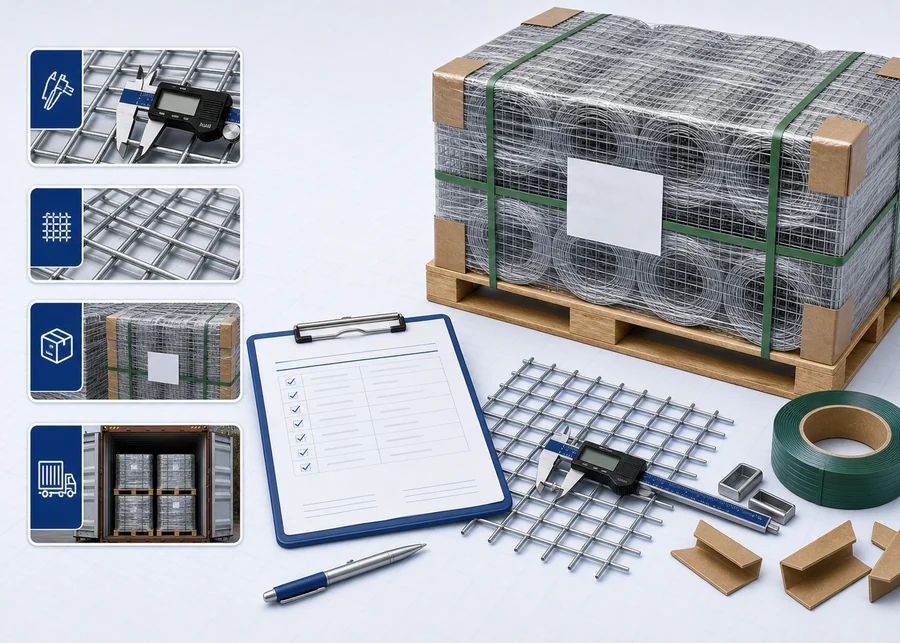
Packing marks should make the shipment easy to identify without exposing private buyer information in public materials. For most wire mesh export orders, the marks need to help the buyer answer five practical questions:
- Which product or SKU is inside this package?
- How many packages belong to this line item?
- Which pallet, roll, carton or bundle is being counted?
- Does this label match the packing list and purchase order?
- Can the receiving team sort the goods without opening every package first?
The label format does not need to be identical for every buyer. A distributor, contractor, retailer and project warehouse may each need different label fields. The important point is alignment: the label, packing list and physical package count should tell the same story.
For broader shipment-control context, the guide on mixed wire mesh container orders explains how packing lists, SKU labels and receiving checks work together in consolidated containers.
Use SKU labels for product-level identification
A SKU label identifies the product inside a roll, bundle, carton, pallet or panel stack. It should be clear enough for the warehouse team to understand the product without opening every package.
Common SKU label fields include:
- buyer SKU or item code;
- short product name;
- specification summary, such as mesh opening, wire diameter, coating, roll size or panel size;
- quantity per package;
- package type, such as roll, bundle, carton or pallet;
- buyer reference or receiving code when required.
Public website images should not show private SKU values, barcode values, PO numbers or buyer company names unless the buyer has approved that use. A neutral example can show the label logic without exposing actual order data.

For private-label programs, the SKU label also becomes part of brand control. The related guide on private label wire mesh orders explains how artwork, SKU records and packing approval can be handled without exposing buyer data in public images.
Add package count marks when receiving accuracy matters
Package count marks help the warehouse confirm whether the full shipment has arrived. They are often written as a sequence, such as `Roll 03 of 48`, `Carton 07 of 24` or `Pallet 02 of 10`.
Useful checks include:
- every package in the same line item has a sequence number;
- the sequence does not skip numbers or repeat numbers;
- the total count matches the packing list;
- the package type on the mark matches the physical package;
- the mark is visible without moving heavy packages.
For multi-product orders, one continuous sequence across all products may create confusion. It is usually clearer to separate product lines, such as `Welded Mesh Roll 01 of 20` and `Fence Accessory Carton 01 of 6`, if the buyer's receiving process supports that format.
Package count marks are not a substitute for unloading and receiving checks. They are a shortcut that helps the team find discrepancies earlier.
Make pallet marks useful for forklift and warehouse teams
Pallet marks summarize what is stacked on each pallet. They are useful when products are moved by forklift, stored as pallet units or received in several warehouse zones.
A practical pallet mark may include:
- pallet number;
- product line or SKU group;
- quantity on the pallet;
- package count linked to the packing list;
- gross weight and net weight when required;
- pallet dimensions when the buyer needs storage planning;
- destination or receiving zone when the buyer provides it.
The exact label design can vary, but the receiving team should be able to match the pallet mark with the packing list. If pallet marks are placed under wrapping film, the text should still be readable from the outside. If several pallets look similar, the labels should be placed in a consistent position.

For public images, visible pallet marks should be neutralized or blurred when they include buyer names, PO numbers, consignee information, barcode values or private shipping marks.
Control private-label marks without leaking buyer data
Private-label wire mesh orders need extra care because the visible packaging may carry the importer's brand, SKU system or retail-facing product name. The goal is to confirm the buyer's required label format without exposing confidential data.
Checks for private-label orders include:
- label artwork matches the approved design file;
- buyer SKU codes match the order record;
- carton marks and pallet marks use the agreed brand or neutral shipping mark;
- factory internal codes are not exposed on buyer-facing labels unless agreed;
- barcode or QR code format is tested with the buyer's system when required;
- public marketing photos hide private buyer data.
Do not assume that every private-label order needs the same fields. Some buyers want full branded retail labels. Others want neutral shipping marks and private SKU data only on internal labels. The label format should be confirmed before packing materials are printed.
Separate marks for mixed containers and accessories
Mixed containers create the highest risk of label confusion. A single container may include wire mesh rolls, panel stacks, fence posts, accessories, cartons and private-label packages. If the labels are too general, the receiving team may not know which package belongs to which product line.
For mixed orders, buyers can ask the supplier to confirm:
- each product line has a separate packing-list line;
- package numbering is separated by product type or SKU group;
- accessory cartons or bags have their own labels;
- small items are not hidden inside larger pallets without a clear outer mark;
- loading photos show how product groups are arranged;
- receiving instructions identify which packages should be counted first.
The guide on wire mesh container loading photos explains what buyers can check when goods are loaded and sealed.

Labels should also match the buyer's unloading plan. If a project site needs posts first, accessories second and panels third, the loading sequence and package marks should help the receiving team find those items quickly.
Receiving checks after the shipment arrives
The label system is only useful if the receiving team uses it consistently. Before goods are moved into storage, the warehouse should compare the package marks with the packing list and note any differences while the shipment is still in the receiving area.
Useful receiving checks include:
- count total pallets, rolls, cartons, bundles and accessory packages;
- compare package sequence numbers with the packing list;
- spot-check selected SKU labels against the product inside;
- photograph missing, damaged or unreadable labels;
- record package damage before products are moved;
- replace damaged internal warehouse labels after the package is identified;
- keep the photo record with the order file.
If labels are missing or damaged, the receiving team should not guess. They should use the packing list, package sequence, product photos and supplier records to identify the package before it enters inventory.
Proof-ready answer: Packing marks are useful when they can be checked against the packing list, package count, product specification and photo record for the same shipment. Buyers should request label close-ups and pallet overviews before loading when receiving accuracy is important, while keeping private buyer codes, PO numbers and barcode values out of public images. These records support warehouse receiving; they do not replace commercial documents, inspection records or the buyer's own inbound count.
Packing mark verification checklist
Use this table before shipment and during receiving. It can be adapted to each buyer's own warehouse process.
| Check area | What to verify | Privacy note | Receiving risk if missed |
|---|---|---|---|
| SKU label | Product code, description, key specification and quantity | Hide buyer SKU values in public images | Products may be sorted into the wrong inventory bin |
| Package count | Roll, carton, bundle or pallet sequence and total count | Sequence can be shown, but private PO data should be hidden | Shortage or duplicate package issues may be found too late |
| Pallet mark | Pallet number, product group, quantity and weight fields | Blur consignee and PO fields in public photos | Forklift team may move the wrong pallet group |
| Accessory label | Clips, caps, C-rings, lacing wire or other small items | Avoid showing buyer project codes | Small items may be treated as missing or mixed |
| Mixed container mark | Product-line separation and loading group | Avoid exposing private shipping marks | Receiving team may need to open every package |
| Private-label mark | Approved artwork, brand position and custom SKU format | Public photos should use neutral examples | Buyer brand presentation may be inconsistent |
| Barcode or QR code | Scan format and readability when required | Do not publish readable code values | Warehouse scanning may fail or map to the wrong item |
| Receiving record | Photos, count notes and label-damage notes | Keep detailed records in private order files | Claims become harder after goods enter storage |
Standard marks vs private-label marks
| Element | Standard export marks | Private-label or buyer-specific marks |
|---|---|---|
| Brand display | Supplier or neutral product reference when agreed | Buyer's brand, neutral shipping mark or custom label format |
| SKU code | Supplier product code or generic item code | Buyer's SKU or inventory code |
| Product description | Standard product naming | Buyer catalog naming or private item name |
| Pallet mark | Package count, product group and weight fields | Buyer format, receiving zone or private PO reference |
| Barcode or QR code | Usually optional | Often linked to buyer warehouse or retail system |
| Photo sharing | Can use neutral public examples | Public images should hide brand, SKU and code values |
| Main risk | Slow receiving or package mismatch | Receiving mismatch plus buyer-data exposure or brand inconsistency |
Frequently asked questions
What should be included on a wire mesh packing label?
A practical label usually includes a product name, buyer SKU or item code, specification summary, package quantity and package number. Depending on the order, it may also include pallet number, gross weight, net weight, barcode or receiving reference. The exact fields should match the buyer's packing-list and warehouse process.
Should packing labels show the buyer's brand?
Only when the buyer requires it. Some private-label buyers need branded labels. Others prefer neutral marks for shipping and private SKU data only for receiving. Public website photos should not show buyer brands unless the buyer has clearly approved that use.
Are QR codes or barcodes recommended?
They can be useful when the buyer's warehouse system supports scanning. The buyer should provide the code format and test requirements before mass label printing. Public photos should hide full code values because barcode or QR data can expose private order or product information.
How should mixed container labels be organized?
Each product line should be easy to identify on the packing list and on physical packages. Product-line numbering, accessory labels and pallet grouping can help the receiving team sort the shipment without opening every package first.
What should the warehouse do if labels are damaged?
The warehouse should photograph the damaged label, identify the package using the packing list and product records, and apply an internal replacement label before storage. If label damage is repeated across shipments, the buyer and supplier should review label material and placement.
Do packing marks replace receiving inspection?
No. Packing marks help identify and count the shipment, but they do not replace product inspection, packing-list verification or QC checks. They should be used together with receiving records and shipment documentation.
Prepare packing mark requirements before production ends
Packing marks and shipping labels are easiest to correct before packing materials are printed and packages are wrapped. Buyers should send label format, SKU list, package numbering rules, private-label artwork and receiving requirements before final packing begins.
ANJIA GROUP can review wire mesh packing mark and label requirements for order-specific discussion. Send product specifications, SKU records, packing-list format and label rules through the ANJIA inquiry page before shipment planning is finalized.
About ANJIA GROUP
ANJIA GROUP supplies wire mesh, fencing and related industrial products for global B2B buyers. Contact our team to discuss product specifications, matching accessories and export packing.
Discuss your sourcing requirements
Send your product requirements and any relevant drawings to our team.
Get a Free Business Quote Wire Mesh and Fence Products
 Wire Mesh Products
 Factory, QC & Packing Reference Pack
 Wire Mesh RFQ Checklist