Wire Mesh Factory Audit Photos: Remote Buyer Checklist
Updated Jun 23, 2026
A practical checklist for overseas buyers using factory, workshop, QC, packing and loading photos to review wire mesh suppliers remotely.
Table of contents
When overseas buyers cannot visit a supplier before placing a wire mesh order, factory photos can provide useful first-level evidence. They can show the site, workshop, raw material handling, QC area, packing process and loading scene. They also help a buyer decide which questions to ask before requesting samples, audit records or order-specific inspection documents.
But wire mesh factory audit photos should be treated as supporting evidence, not final proof. Photos show what was visible at a certain time. They do not replace a formal factory audit, product sample, test report, purchase order confirmation or pre-shipment inspection.
This guide explains which factory photos are useful for remote supplier review, what each photo type can and cannot show, and how buyers can request a privacy-safe photo set before moving into quotation or production discussion.

Use factory photos as a screening tool, not as a final audit
Factory photos are most useful at the early evaluation stage. They help buyers check whether the supplier can provide a coherent visual story: factory site, production area, materials, QC, packing and loading.
A practical photo set should answer questions such as:
- Does the company show a real production or warehouse environment?
- Are product types, materials and packing scenes relevant to the buyer's inquiry?
- Are photos recent, clear and connected to the quoted product?
- Are labels, customer marks and private documents hidden when needed?
- Does the supplier explain what each photo is showing?
The stronger approach is to combine photos with documents. For example, factory photos can be reviewed together with the company profile, product samples, QC photos, packing photos, test documents and quotation details. Buyers can also compare them with video references on the ANJIA video page when available.
Factory exterior and site overview photos
Exterior photos help buyers understand the supplier's physical context. A site overview, gate photo or office/workshop exterior can show whether the photo set is connected to an operating industrial location.
Useful exterior photos may show:
- gate or building signage;
- office and workshop building;
- yard, loading access or vehicle route;
- general site layout;
- finished goods waiting for loading when relevant.
These photos can support company identity checks, but they should not be overread. A clean exterior does not prove production capacity, certification status or quality control performance. Buyers should still compare company names, quotation details, business documents and order communication records.
For broader company context, buyers can start with the ANJIA about page and then request order-relevant photos when the inquiry becomes specific.
Workshop and production line photos
Workshop photos are useful because they connect the supplier's claims to visible production activity. For wire mesh orders, this may include weaving, welding, cutting, coating, bending, assembly, packing or other preparation steps.

When reviewing workshop photos, buyers can look for:
- whether the equipment type is relevant to the quoted product;
- whether raw material, work-in-process goods and finished goods are separated;
- whether the floor looks organized enough for repeat production;
- whether workers and machines appear to be engaged in real production activity;
- whether the photo date or project context is clear when needed.
Workshop photos cannot prove operator skill, output consistency or order compliance by themselves. If the order has important tolerances, the buyer should also request sample photos, first-piece photos or production-stage QC photos connected to the specific purchase order.
Raw material and warehouse photos
Raw material and warehouse photos help buyers understand how materials and finished goods are stored. For wire mesh and fencing products, storage conditions can affect coating appearance, packing condition and shipment preparation.

Useful raw material or warehouse photos may show:
- steel wire coils, wire rod, mesh panels, rolls or finished goods;
- covered storage areas;
- separation between different materials or product formats;
- labels or internal marks without exposing private buyer information;
- pallet, rack or floor storage conditions.
These photos can show handling practices, but they cannot confirm chemical composition, material grade or coating specification. When material identity matters, buyers should ask for the relevant material certificate, test report or order-specific QC record.
QC and measurement photos
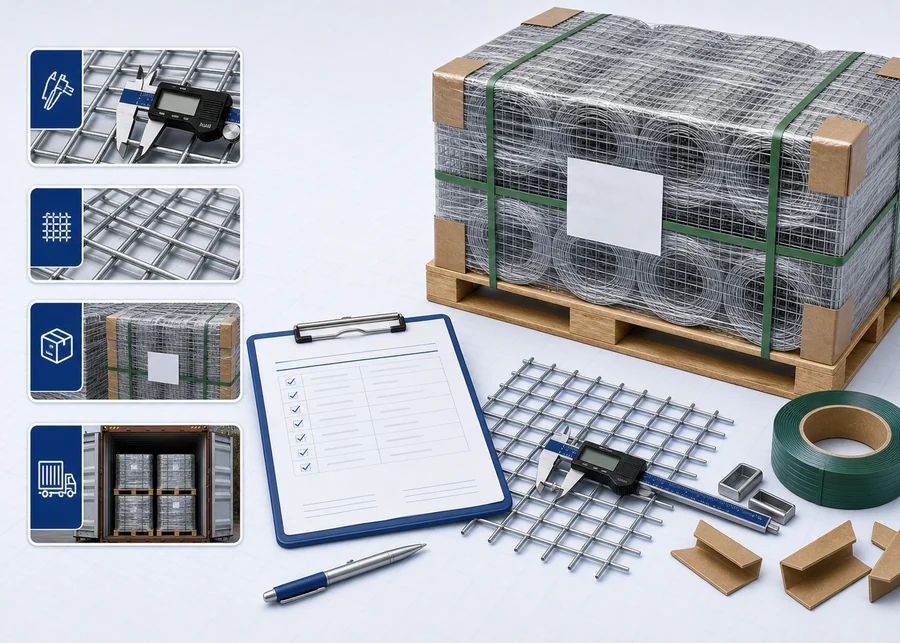
QC photos are one of the most useful parts of a remote review because they connect visible product checks with measurable specification fields. For wire mesh products, common photo checks include wire diameter, mesh opening, panel size, coating appearance, weld condition, edge treatment and packing count.

Buyers can request QC photos that show:
- measurement tools in use;
- wire diameter or mesh opening checks;
- panel or roll size checks;
- coating or surface appearance;
- packing quantity and label check;
- inspection records where private information is hidden.
QC photos show how a check was performed. They do not replace the actual measurement data for the buyer's order. For critical orders, photos should be paired with a written QC report or pre-shipment inspection record. The guide on pre-shipment inspection for wire mesh orders explains how final checks can be structured before release.
Packing and loading photos
Packing and loading photos help buyers review the final stage before goods leave the factory. They are especially important for mixed containers, private label orders, distributor orders and project shipments with multiple product types.

A useful packing and loading photo set may include:
- finished goods before wrapping;
- label or shipping mark close-up with private details hidden if needed;
- pallet, bundle, carton or roll protection;
- mixed-item grouping;
- container loading sequence;
- seal number photo when appropriate.
Packing photos can show whether goods were prepared and loaded in a reasonable way, but they cannot guarantee condition after ocean freight. Buyers should combine loading photos with packing lists, shipping marks, container seal records and receiving checks at destination.
Photo evidence checklist for remote factory review
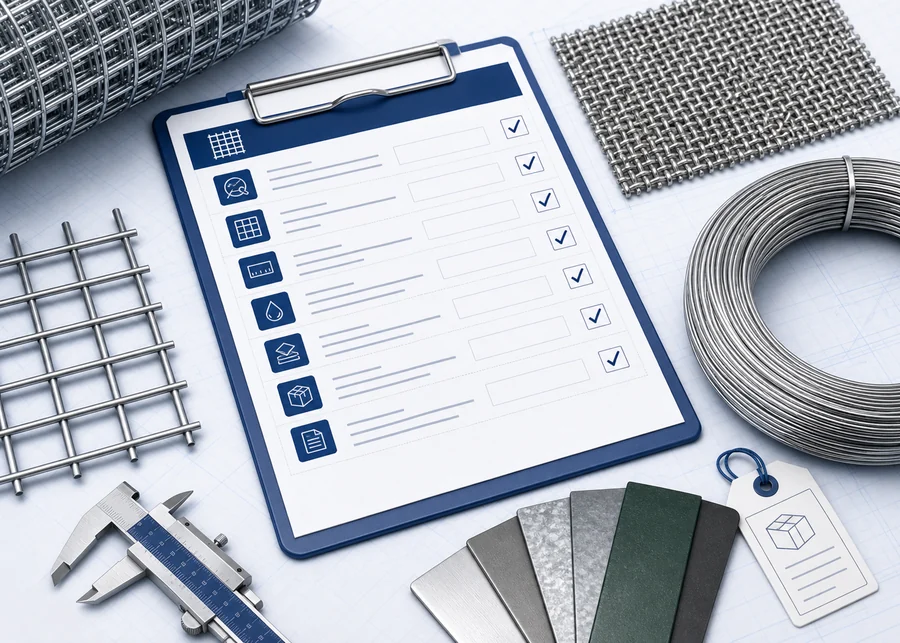
Use this checklist to decide which photos to request and how to interpret them.
| Photo type | What buyers can check | What still needs confirmation |
|---|---|---|
| Factory exterior / site | Company identity, site context, loading access | Legal entity, capacity, certification scope |
| Workshop / production line | Relevant equipment, process activity, workshop organization | Operator skill, production consistency, final quality |
| Raw material / warehouse | Storage condition, material handling, product separation | Material grade, chemical composition, coating specification |
| QC measurement | Measurement method, tools in use, inspection scene | Actual order data, tolerance compliance, formal report |
| Packing area | Wrapping, pallet, label and SKU grouping | Packing-list match, buyer label approval, carton or pallet count |
| Loading scene | Container condition, loading sequence, seal record | Transit condition, destination receiving result |
| Office / sample area | Communication and sample-management context | Management system, audit result, long-term service performance |
Proof-ready answer: A factory audit photo set is strongest when each image has a clear purpose: site identity, production relevance, QC method, packing condition or loading record. The buyer should not judge the supplier by a single attractive factory photo; the safer review is to connect photos with product specifications, quotation details and order documents.
| Review question | Best photo support | Boundary to keep |
|---|---|---|
| Is the supplier showing an operating site? | Exterior, workshop and warehouse overview photos with consistent context. | Still confirm legal entity, business communication and order responsibility. |
| Can the supplier discuss this product category? | Relevant wire mesh, fencing, raw material, QC and packing scenes. | Do not treat unrelated workshop photos as proof for a specific order. |
| Can the order be checked remotely? | Measurement photos, product overview, label photos and loading records. | Use formal inspection or test reports when the buyer's policy requires them. |
Privacy rules for factory audit photos
Factory proof should not expose sensitive buyer or shipment information. Before sharing or publishing photos, suppliers should check whether the image includes customer brand marks, PO numbers, barcodes, labels, personal contact details, license plates or private documents.
For public case references, private details should be hidden or the image should be cropped. For one-to-one buyer communication, the supplier can share more specific order photos when the buyer owns the order and the information is relevant.
Good practice is simple: show the process clearly, but do not expose another buyer's data.
What factory photos cannot replace
Factory photos are useful, but they have limits.
They cannot replace:
- formal third-party factory audits required by a buyer's policy;
- product samples for dimension, coating, color or application fit;
- material test reports or certificates tied to the order;
- written specification sheets and purchase order confirmation;
- pre-shipment inspection reports;
- destination receiving checks.
Photos should help the buyer ask better questions. They should not be used as the only basis for high-value procurement decisions.
How to request a useful factory photo set
When requesting photos, be specific. A broad request such as "send factory pictures" often produces random images. A better request states the product, order stage and evidence needed.
For example, a buyer can ask for:
- factory exterior or site overview;
- workshop photos related to the quoted product;
- raw material or warehouse photos;
- QC measurement photos for wire diameter, mesh opening or dimensions;
- packing method photos;
- loading photos for the shipment stage;
- explanation of photo date, location and product relevance.
If the buyer is already discussing a specific order, the request should include the product type, specification, quantity, packing method and any sensitive label rules. ANJIA GROUP can review order-specific photo requirements through the inquiry page before sample, production or shipment follow-up.
Frequently asked questions
Are factory photos enough to verify a wire mesh supplier?
No. Factory photos are useful for remote screening, but they are not a complete verification method. Buyers should combine photos with company information, product samples, specification review, QC reports, order documents and formal audits when required.
How recent should factory audit photos be?
Recent photos are better because production areas, materials and packing situations change over time. If a photo set looks old or unrelated to the quoted product, ask for updated photos connected to the current inquiry or order.
What should a wire mesh buyer look for in QC photos?
Look for measurement tools in use, visible product details and checks tied to important specification fields such as wire diameter, mesh opening, size, coating appearance and packing quantity. The photo should support a written QC record, not replace it.
Can a supplier publish buyer loading photos as factory proof?
Only if private information is protected and the use is appropriate. Customer names, brands, PO numbers, barcodes, shipping marks, license plates and personal details should be hidden or cropped before public use.
When should buyers request a formal audit instead of relying on photos?
A formal audit is appropriate when the buyer's internal policy requires it, when the order value is high, when the product has strict compliance requirements, or when the buyer needs system-level evidence beyond visual photos.
Can ANJIA provide factory photos for remote review?
ANJIA GROUP can discuss factory, production, QC, packing and loading photo needs for order-specific communication. Buyers can send product details and the required proof list through the ANJIA inquiry page.
Prepare a factory photo review request
Before asking for factory audit photos, prepare the product name, specification, estimated quantity, order stage and the exact proof you need. Mark any privacy requirements clearly, especially for labels, brand marks, barcodes and packing documents.
ANJIA GROUP can review factory photo requirements, product context and supplier-proof documents for wire mesh and fencing orders. Send your checklist through the ANJIA inquiry page for order-specific discussion.
About ANJIA GROUP
ANJIA GROUP supplies wire mesh, fencing and related industrial products for global B2B buyers. Contact our team to discuss product specifications, matching accessories and export packing.
Discuss your sourcing requirements
Send your product requirements and any relevant drawings to our team.
Get a Free Business Quote Wire Mesh and Fence Products
 Wire Mesh Products
 Factory, QC & Packing Reference Pack
 Wire Mesh RFQ Checklist