
Railing Fence RFQ Checklist for Barrier Panel Facility Projects
Updated Jun 30, 2026
A practical checklist for importers preparing railing fence or barrier panel RFQs with posts, accessories, coating and packing proof.
Table of contents
This railing fence RFQ checklist helps buyers prepare barrier panel orders with more than a panel price. A quote-ready RFQ should define the panel style, height, rail or bar profile, post system, coating, accessory list, packing method and proof records before production starts.
This checklist is written for importers, contractors and project buyers preparing railing fence inquiries for facility boundaries, landscape separation, commercial perimeters or project barrier areas. It does not claim a safety rating, pedestrian barrier compliance, load resistance or local code approval. Those points must be verified with project documents and qualified local requirements.
Use this article to make the inquiry clearer before comparing supplier quotations. Final drawings, approved samples, site measurements, purchase documents and local compliance requirements should still control the order.

Quick answer for project buyers
A railing fence or barrier panel RFQ should begin with the project boundary, not only the panel name. Buyers should confirm panel height and width, wire or tube profile, post type, base plate or embedded fixing method, coating system, color, accessories, packing and destination handling. Supplier-side proof can include panel photos, post and accessory matching photos, coating color reference, pallet packing photos and loading records. These checks help align quotation and receiving, but they do not replace local engineering approval or certified safety-barrier requirements. If a project needs a specific standard, load rating, anti-corrosion class or installation rule, that document should be shared before quotation so the supplier can review the manufacturable scope, accessory list, inspection points and document expectations. A clearer RFQ also reduces the risk of under-quoted posts, missing anchors or mismatched finish.
RFQ evidence snapshot
| RFQ evidence | Buyer use | Supplier-side check |
|---|---|---|
| Project layout or drawing | Confirms line length, gate points and post spacing assumptions | Reviews panel size, post route and accessory scope |
| Panel and post sample photo | Aligns visual expectation before bulk order | Checks profile, weld, coating and fixing details |
| Coating color or finish reference | Reduces mismatch across panels, posts and accessories | Matches powder coating, hot dip galvanized or PVC coated route |
| Packing and label requirement | Supports site receiving and mixed-item control | Plans pallet, bundle, label and loading sequence |
Start with the project boundary
Many buyers ask for "railing fence" or "barrier panels" before the project details are defined. Those names can describe different products in different markets. Before asking for price, define where the fence will be used and what information the supplier needs.
Start with these questions:
- Is the fence for a facility boundary, landscape area, commercial perimeter or internal separation?
- Does the buyer have a drawing, site layout or reference photo?
- What panel height, panel width and post spacing are expected?
- Should the system use vertical bars, formed rails, framed panels or another agreed style?
- Are fence posts concrete-set, base-plate mounted or project-specific?
- What coating and color are required?
- How should panels, posts and accessories be packed and labeled?
This step keeps the RFQ practical. It also avoids a common mistake: one supplier quotes only panels while another supplier includes posts, clips, caps and packing.
Panel dimensions and profile
Panel dimensions should be written as order fields, not described only by a reference image. Railing fence may use vertical bars, rails, formed profiles, decorative tops or frame-like details depending on the project and local market.

Confirm:
- overall panel height and panel width;
- whether height includes decorative top details;
- vertical bar, pale, rail or frame profile;
- bar spacing or opening size if required;
- top rail and bottom rail profile;
- intermediate rail position if included;
- panel end detail and connection position.
If the buyer needs the product to match an existing fence line, use a drawing or sample photo. A small difference in top profile, bar spacing or color can be visible after installation even when the quotation looks similar.
Post system and mounting method
Posts are not a secondary detail. Post size, post length, base plate and mounting method can change the quotation, packing plan and installation readiness.

Ask the supplier to separate these post fields:
- square, round, Y-type or other post profile;
- post size and wall thickness if required;
- post length, embedment depth or base plate height;
- base plate size and hole pattern if surface mounted;
- post cap type and color;
- spacing confirmed by project layout;
- quantity by line post, corner post, end post and gate post if applicable.
Post spacing should not be treated as a universal rule. It should follow panel width, project layout, site transitions and local requirements. If a safety or load requirement applies, it must be reviewed outside the general product RFQ.
Coating and appearance checks
Railing fence and barrier panels are often visible in public or commercial areas, so coating and appearance details matter. The RFQ should define the coating route and the acceptance reference clearly.
Common fields include:
- galvanized, powder coated, PVC coated or galvanized plus powder coated route;
- RAL color or approved color sample;
- coating thickness requirement if specified by the order;
- whether welding happens before coating;
- visible surface expectations, such as color consistency and obvious coating defects;
- sample approval if the project is appearance-sensitive.
Do not treat coating as a service-life guarantee. Environment, installation, maintenance and local exposure all affect long-term performance. Samples, photos and test records can support review, but they do not replace project-specific requirements.
RFQ checklist table
Use this table to keep the supplier quotation, drawing review and packing discussion aligned.
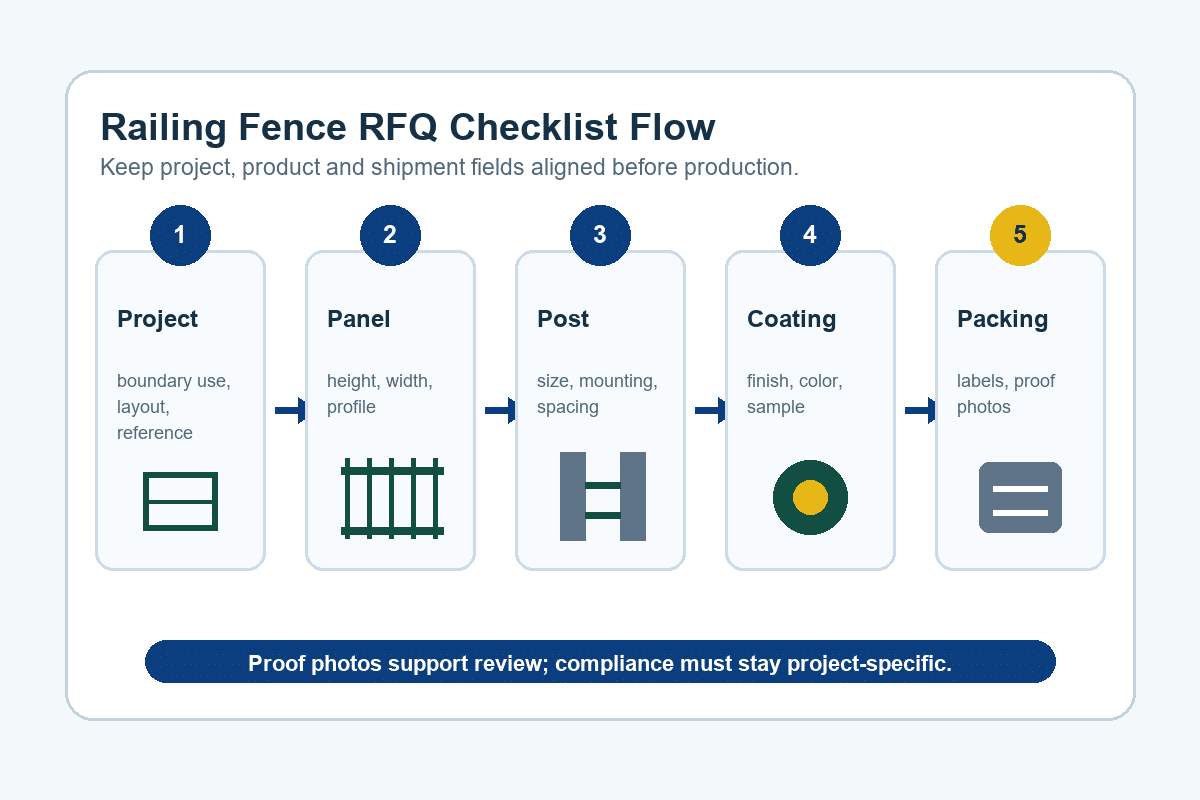
| RFQ field | What to specify | Buyer question | Proof or document to request |
|---|---|---|---|
| Application | Facility boundary, landscape, commercial perimeter or internal separation | What is the project use and site condition? | Layout sketch, reference photo or drawing |
| Panel size | Height, width and quantity | Does height include decorative top details? | Dimension drawing or approved sample |
| Panel profile | Vertical bar, rail, pale, frame or formed profile | Which style should supplier quote? | Product photo, profile drawing or sample photo |
| Post system | Post size, length, cap, base plate or embedment | How do panels connect to posts? | Post drawing and connection detail |
| Coating | Finish route, color and surface expectation | Which coating route and color are required? | Color sample, coating record or inspection photo |
| Accessories | Brackets, bolts, clips, caps and spare parts | Are accessories included or quoted separately? | Accessory list and carton photos |
| Packing | Panel bundle, post bundle and accessory cartons | How will items be counted at loading? | Packing list, labels and pallet overview |
| Proof records | Photos and shipment documents | Which product groups must be visible? | Loading photos and container seal record |
Accessories and small parts
Small parts cause many practical problems when they are not listed clearly. A railing fence RFQ should not simply say "with accessories." It should list what those accessories are and how they will be packed.
Useful accessory fields include:
- panel-to-post brackets or clips;
- bolts, nuts, washers and anchors;
- post caps and rail end caps;
- base plates if used;
- touch-up paint if agreed;
- spare accessory percentage if needed;
- accessory carton labels and carton count.
Accessory cartons should be connected to the packing list. If one container includes several panel sizes or project sections, accessory labels should make receiving easier.
Packing, labeling and proof photos
For railing fence and barrier panel orders, packing should protect the finish and keep panels traceable. The buyer should confirm the packing method before production release, not only at loading.

Ask for:
- panel bundle quantity and pallet type;
- spacer or film protection for coated surfaces;
- post bundle count and post length;
- accessory carton quantity and labels;
- bundle number and total bundle count;
- net weight and gross weight if required;
- photos of labels, bundle overview, loaded container and seal.
Photos and packing records support shipment review, but they do not prove site compliance or replace arrival inspection. They are evidence that the correct product groups were prepared and loaded.
When to compare related fence products
Railing fence may overlap with other perimeter products in buyer discussions. The comparison should be based on project use and specification fields, not only appearance.
Consider:
- frame fence when the project needs a framed welded mesh panel style;
- 3D welded mesh fence when V-bend welded mesh panels fit the project better;
- palisade fence when the buyer is comparing vertical pale security-style products;
- security fence when the project has higher perimeter-security requirements.
The buyer should avoid treating these products as interchangeable. Panel construction, posts, accessories, coating and packing can all differ.
Common RFQ mistakes to avoid
Avoid these issues before supplier comparison:
- asking for barrier panels without clarifying whether posts and accessories are included;
- using a reference photo but not confirming height, width and profile;
- treating post spacing as fixed without project layout confirmation;
- requesting a coating color but not providing RAL code or sample reference;
- asking for safety or load performance without project documents;
- forgetting accessory carton labels;
- requesting proof photos but not saying which product groups must be visible.
Clear RFQ fields make quotation comparison easier and reduce revision cycles before production.
Frequently asked questions
Is railing fence the same as a certified safety barrier?
Not automatically. Railing fence may be used for separation, perimeter or project boundary purposes, but safety rating, pedestrian barrier compliance, impact resistance and local code approval require project-specific documents and qualified review.
Can post spacing be decided by the supplier?
The supplier can recommend a spacing based on panel width and product design, but the buyer should confirm it against the project layout and local requirements. If engineering or compliance requirements apply, they should be provided in the RFQ.
Should accessories be quoted separately?
For clarity, yes. Even when accessories are included in the final offer, the RFQ should list brackets, bolts, caps, base plates and spare parts separately so the buyer can check packing and receiving.
What proof photos are useful before shipment?
Useful photos include panel overview, post bundles, accessory cartons, labels, pallet packing, container loading and seal number. They support shipment review but do not replace arrival inspection.
Prepare a railing fence RFQ
For order-specific support, send your drawing, reference photo, panel dimensions, post requirement, coating request, accessory list and packing preference through the ANJIA inquiry page. The team can help review which railing fence, post and packing fields should be confirmed before quotation or sample approval.
About ANJIA GROUP
ANJIA GROUP supplies wire mesh, fencing and related industrial products for global B2B buyers. Contact our team to discuss product specifications, matching accessories and export packing.
Discuss your sourcing requirements
Send your product requirements and any relevant drawings to our team.
Get a Free Business Quote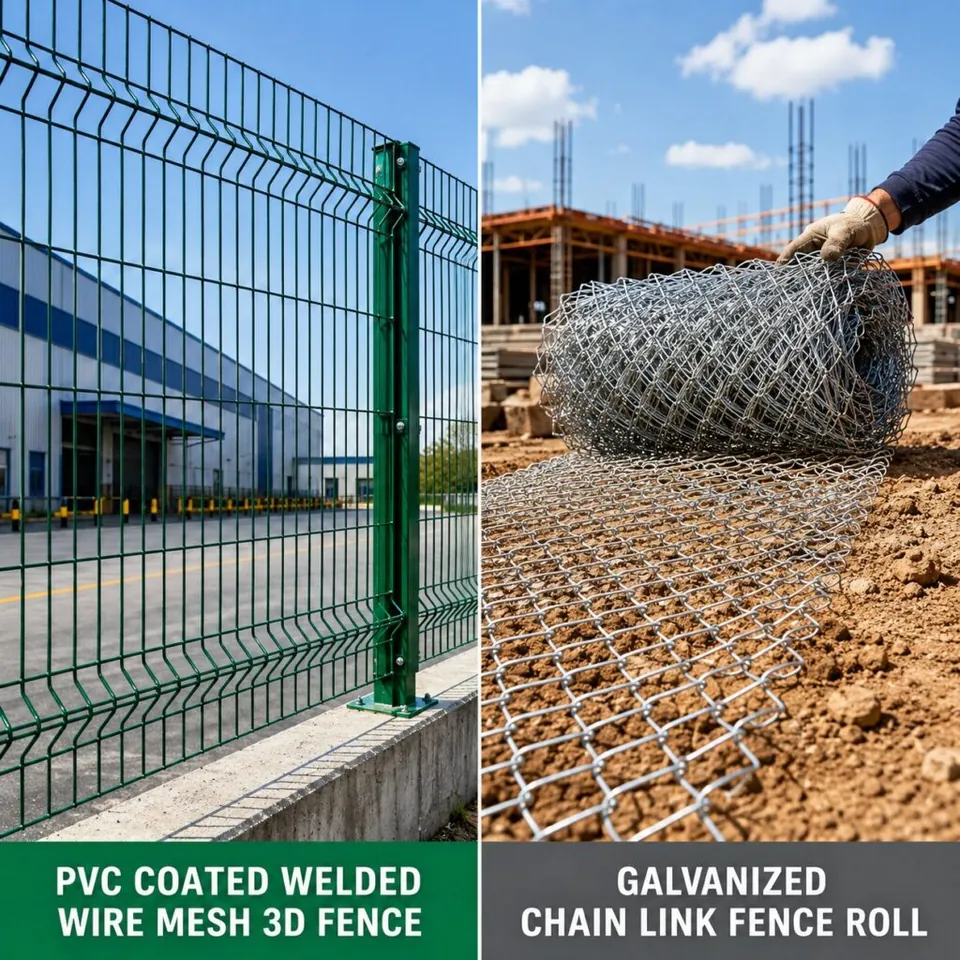 Railing Fence
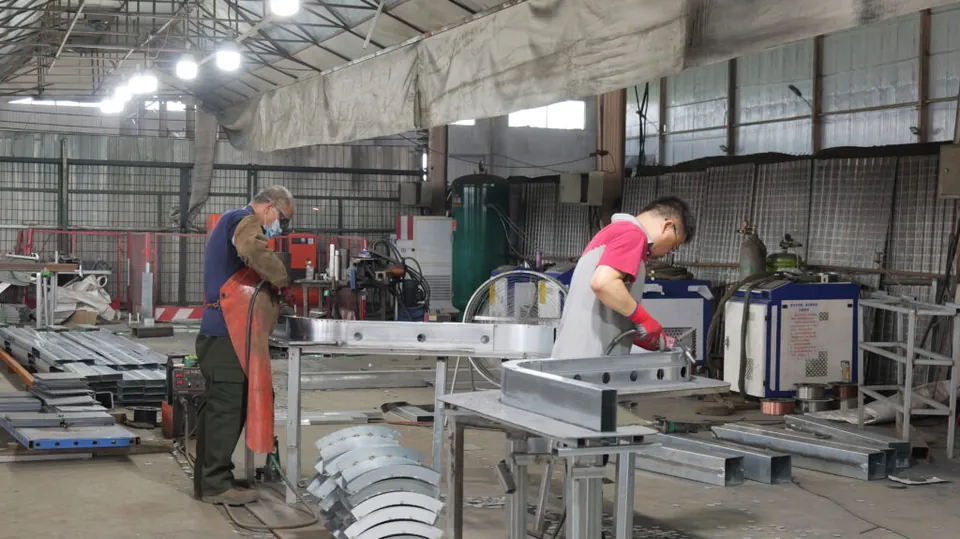 Fence Post
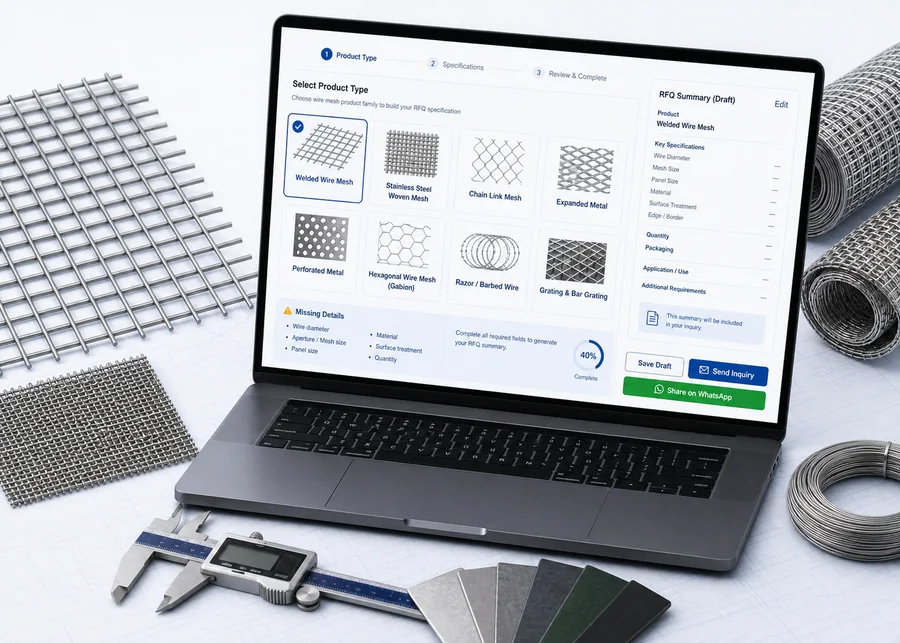 Wire Mesh RFQ Specification Builder
 Wire Mesh RFQ Checklist