
Stainless Steel Wire Mesh 304 vs 316: How Buyers Should Confirm Grade, Weave and Use

Updated Jun 24, 2026
Use this guide to prepare a clearer RFQ for stainless steel wire mesh rolls, sheets and cut pieces.
Table of contents
Many stainless steel wire mesh inquiries start with a short description such as "100 mesh stainless steel mesh, 1 meter wide." That is not enough for a reliable quotation. The supplier still needs to know the stainless grade, weave type, wire diameter, opening requirement, roll or sheet size, packing method and final use.
This guide explains how B2B buyers can compare stainless steel wire mesh options without over-specifying or leaving important fields unclear. The goal is not to turn every buyer into a metallurgist. The goal is to send an RFQ that a factory can price, produce and inspect consistently.
Confirm grade, mesh and weight together
For stainless steel wire mesh, grade selection is only one part of the quotation. A buyer comparing 304 and 316 should also confirm weave type, mesh count, wire diameter, opening, roll width, cut size and packing. If these fields are not aligned, a 304 quote and a 316 quote may be comparing different products rather than only different grades.
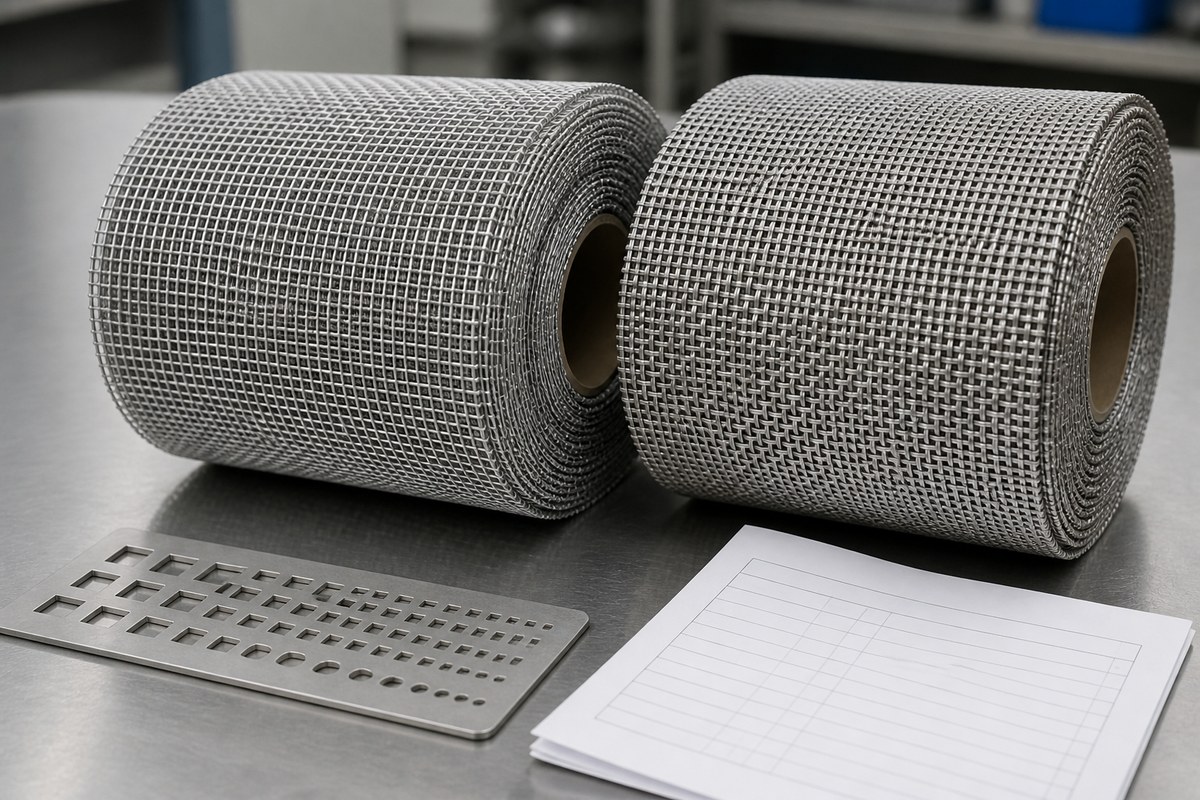
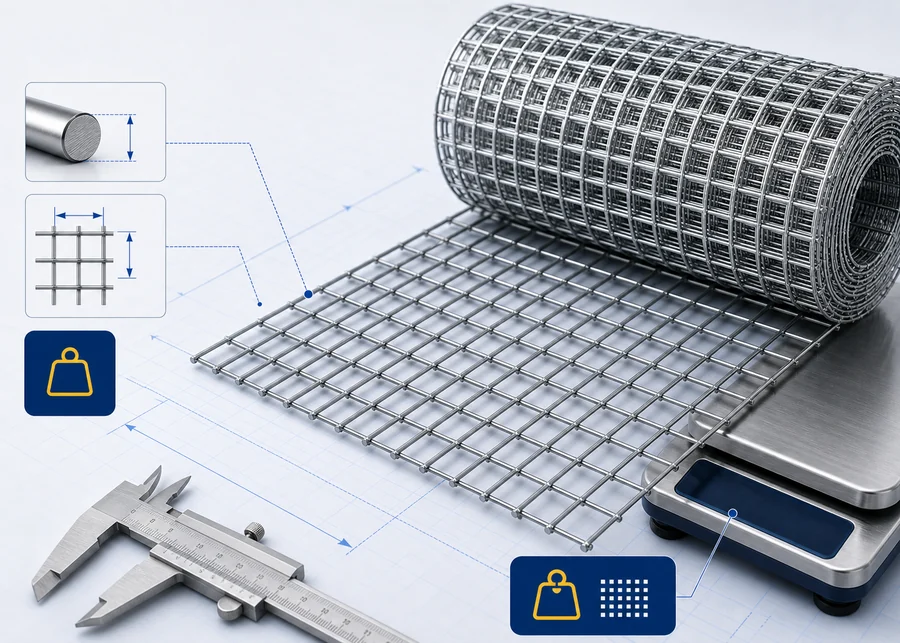
Unit weight or roll weight is a useful cross-check when available. With the same grade and roll size, mesh count and wire diameter can change weight, open area, rigidity and cost. If a buyer has a previous roll label, receiving weight or equipment specification, sharing that reference helps the supplier detect whether the new RFQ has the same mesh structure.
Grade proof also has limits. A certificate or material statement can support traceability when required, but it does not confirm whether the selected mesh count, opening and packing are suitable for the buyer's filtration, screening or fabrication use. If the mesh will contact food, chemicals, moisture, salt or cleaning agents, the buyer should describe the exposure and confirm whether 304, 316 or 316L is the intended quotation basis.
For repeat buying, keep one RFQ sheet that records grade, weave, mesh count, wire diameter, size, weight reference, edge requirement, packing and destination. This makes future comparisons more reliable and reduces the chance of approving a lower price that is based on a lighter or different mesh structure.
1. Quick Decision Table for Buyers
Before comparing 304 and 316, confirm the practical buying situation. The same grade can be suitable or unsuitable depending on environment, contact material, cleaning method and whether the mesh will be welded into a frame later.
| Buyer Question | What to Confirm | Why It Matters |
|---|---|---|
| Grade | 304, 316 or 316L, with material certificate if required | Controls corrosion resistance and sourcing cost |
| Use environment | Dry indoor, humid, coastal, chemical, food contact, filtration or decorative use | Helps avoid both under-specification and unnecessary premium |
| Weave type | Plain weave, twill weave, plain Dutch or twill Dutch | Changes opening shape, strength, flow and price basis |
| Mesh count / opening | Openings per inch, aperture, or buyer-required filtration basis | Mesh count alone may not define the actual opening |
| Wire diameter | Wire diameter and tolerance, if the application is critical | Affects strength, open area and final weight |
| Supply form | Roll, sheet, disc, strip, cut piece or framed part | Affects production, trimming, packing and inspection |
| Packing | Roll core, moisture protection, carton, wooden case, pallet and labels | Protects mesh edges and surface during export shipment |
2. 304, 316 and 316L: What Buyers Should Actually Confirm
In ordinary purchasing language, 304 is often used as a general-purpose stainless steel mesh grade. 316 is usually considered when the buyer expects stronger corrosion exposure, especially chloride or more demanding wet conditions. 316L is a low-carbon version commonly discussed when later welding or welded assemblies are involved.
For public buying content, it is better not to rely only on a grade name. Ask the supplier to state the grade on the quotation and provide a material certificate when the application requires traceability. If the mesh will be used in food processing, chemical filtration, marine-adjacent environments or equipment assemblies, tell the supplier the actual operating environment instead of only asking, "Which grade is cheaper?"
3. Weave Type Changes More Than Appearance
The weave type determines how wires cross, how stable the mesh is, how the opening behaves, and how suitable the mesh is for screening or filtration. For common square openings, plain weave is often the simplest quotation basis. Twill weave may be considered when finer mesh or stronger wire support is needed. Dutch weave uses different wire arrangements and is often discussed for finer filtration requirements.
Because each weave structure can change flow, strength and opening behavior, buyers should not compare two offers only by "mesh count." A 100 mesh plain weave and a Dutch weave specification are not the same product path. If the application is filtration, ask whether the supplier can provide sample inspection, opening confirmation or production photos.

4. Mesh Count, Opening and Wire Diameter Should Be Confirmed Together
Mesh count tells how many openings appear within a linear inch. It is useful, but it does not fully define the product. Wire diameter also matters. With the same mesh count, a thicker wire usually means a smaller opening and stronger mesh. A thinner wire may give more open area but less mechanical strength.
For regular screening and general industrial use, a buyer may start with mesh count and roll size. For filtration, equipment assembly or repeat purchasing, the RFQ should include mesh count, wire diameter, opening requirement if available, tolerance expectations and the intended use. This helps avoid receiving quotes that look similar but cannot perform the same job.
- Do not specify only "100 mesh" if the opening is important.
- Do not specify only "304 stainless steel" if corrosion exposure matters.
- Do not specify only "roll width" if cut size, sheet size or edge trimming is required.
- Do not assume every supplier uses the same packing method for fine mesh rolls.
5. Match Grade and Structure to the Application
The most useful stainless steel wire mesh quotation is based on the application, not only the lowest material price. Buyers can use the table below as a conversation guide, not as a universal engineering rule.
| Application Situation | Often Discussed Specification Point | Buyer Should Confirm |
|---|---|---|
| Dry screening or general separation | 304, plain weave, required mesh count | Opening, wire diameter, roll width and packing |
| Humid or coastal environment | 316 may be considered | Actual exposure, cleaning method and certificate requirement |
| Food or clean processing | Grade traceability and smooth surface handling | Material certificate, packing hygiene and contact condition |
| Fine filtration | Twill or Dutch weave may be discussed | Opening or filtration basis, sample check and tolerance |
| Decorative or architectural use | Appearance, flatness and edge finish | Visible surface, sheet size, cut edge and packing protection |
| Welded frame or basket assembly | 316L may be discussed if welding is involved | Whether the mesh will be welded after delivery and certificate needs |
6. Packing and Inspection Are Part of the RFQ
Stainless steel wire mesh can be damaged by edge deformation, moisture, heavy stacking or careless handling. Fine mesh is especially sensitive. Ask how rolls, sheets or cut pieces will be packed before confirming the order.
A practical export packing plan may include inner wrapping, roll core, carton, wooden case, pallet, product label and batch marking. For repeat orders, buyers should also request product photos, packing photos and basic inspection records. The same principle applies to other wire mesh products; the wire mesh export packing checklist can be used as a wider reference.
7. RFQ Checklist for Stainless Steel Wire Mesh
Before asking for price, prepare these fields. If a field is unknown, describe the working condition and ask the supplier to quote with a clearly stated assumption. For a wider RFQ structure across wire mesh products, buyers can also compare this with the wire mesh quotation checklist.
| RFQ Field | Example Buyer Input |
|---|---|
| Grade | 304, 316 or 316L; certificate required or not |
| Weave type | Plain, twill, plain Dutch, twill Dutch, or supplier recommendation based on use |
| Mesh count / opening | Mesh count, opening size, or filtration target if already known |
| Wire diameter | Required wire diameter or supplier quotation basis |
| Size | Roll width and length, sheet size, disc size, strip size or cut-to-size request |
| Quantity | Square meters, rolls, sheets, pieces or container planning |
| Application | Screening, filtration, decoration, equipment assembly or other use |
| Packing | Carton, wooden case, pallet, label, moisture protection or custom mark |
| Destination | Port, country and preferred trade term if available |
Frequently Asked Questions
Is 316 stainless steel wire mesh always better than 304?
Not always. 316 is often selected for stronger corrosion exposure, but 304 may be suitable for many dry, indoor or less corrosive uses. The better choice depends on environment, contact material, cleaning method and required traceability.
When should buyers ask for 316L instead of 316?
316L is commonly discussed when the mesh will be welded into frames, baskets or assemblies after weaving. Buyers should tell the supplier whether post-processing or welding is planned and request certificate details if the application is critical.
Can mesh count alone define stainless steel wire mesh?
No. Mesh count should be confirmed together with wire diameter and opening requirement. Two meshes with the same count can still have different open area, strength and flow behavior.
What should be checked before approving a stainless mesh sample?
Check grade marking or certificate, weave type, mesh count, wire diameter, roll width or cut size, surface condition, edge handling and packing. For filtration use, confirm whether additional inspection is required.
What should I send to get a faster quotation?
Send grade, weave type, mesh count or opening, wire diameter, width, length or cut size, quantity, application, packing request and destination. If you are unsure, send the application and ask for a stated quotation basis.
Conclusion: Grade Is Only the First Decision
Choosing between 304 and 316 is important, but it is only one part of a complete stainless steel wire mesh specification. Weave type, mesh count, wire diameter, size, application and packing can change the real product as much as the grade itself.
For repeat buying, the safest approach is to create a standard RFQ sheet and use it for every supplier comparison. If you are preparing a first inquiry, start with the grade and use environment, then add weave, mesh count, wire diameter and packing details before sending the request through the stainless steel wire mesh inquiry form.
About ANJIA GROUP
ANJIA GROUP supplies wire mesh, fencing and related industrial products for global B2B buyers. Contact our team to discuss product specifications, matching accessories and export packing.
Discuss your sourcing requirements
Send your product requirements and any relevant drawings to our team.
Get a Free Business Quote Stainless Wire Mesh
 Stainless Steel Wire
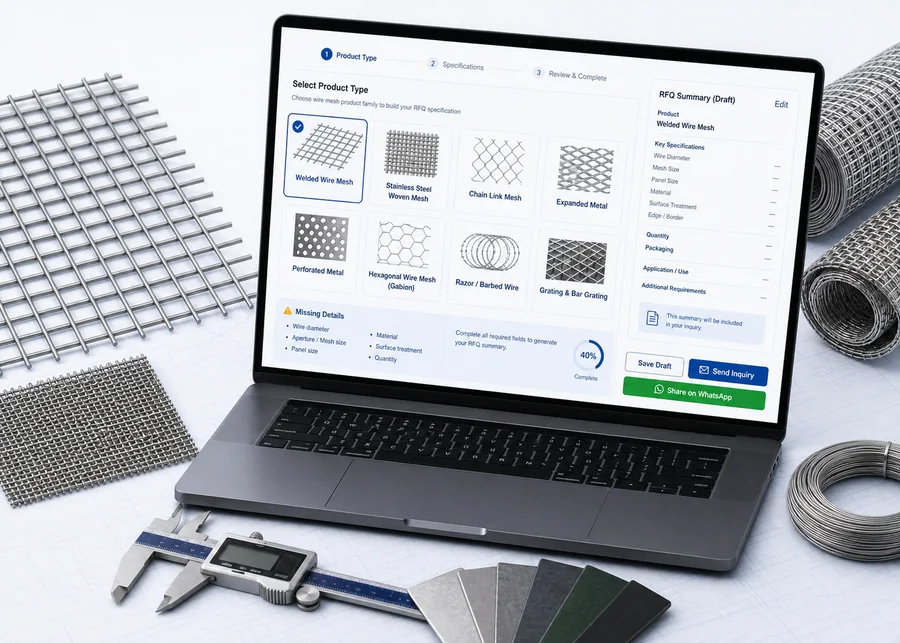 Wire Mesh RFQ Specification Builder
 Wire Mesh Weight Calculator