
Crimped Wire Mesh Buying Guide: Wire Diameter, Opening, Weave Type, Material and Application

Updated Jun 23, 2026
Specify crimped wire mesh by wire diameter, clear opening, weave type, material, finish, size, edge treatment, packing and RFQ details before comparing offers.
Table of contents

Crimped wire mesh is woven from wires that are crimped before weaving. The wave-shaped wire profile helps the wires sit firmly at the crossing points, creating a semi-rigid mesh that is often used for screening, barbecue grills, guards, decorative panels and industrial applications.
For buyers, the challenge is not the product name. The same "crimped wire mesh" request can mean different wire diameters, opening sizes, weave types, materials, finishes, edge treatments and packing methods. A clear specification helps buyers compare quotations on the same basis.
This guide explains the main points to confirm before requesting a crimped wire mesh quotation.
What buyers should confirm first
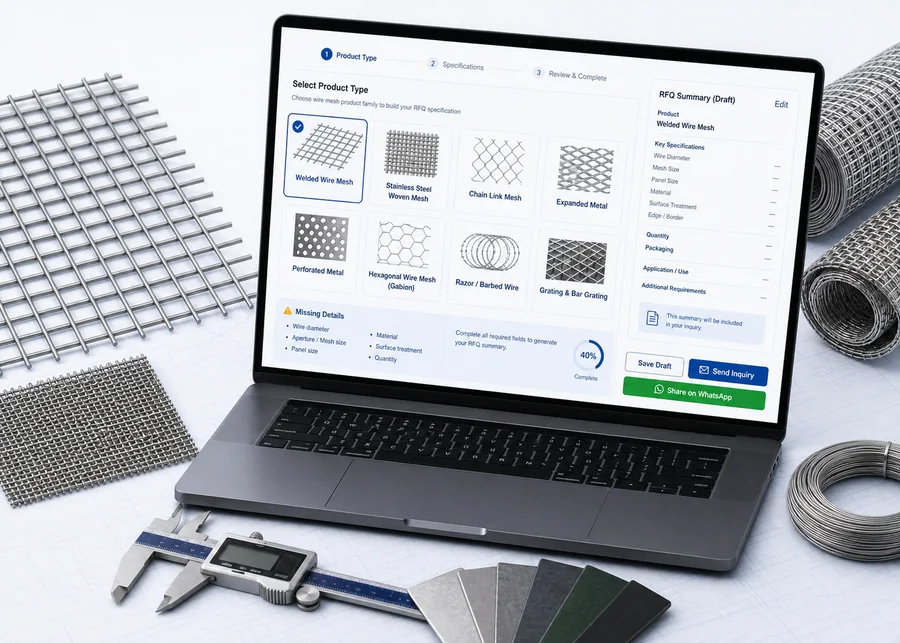
Before comparing prices, prepare the main specification in one line:
- Wire diameter in millimeters.
- Clear opening size, such as 10 x 10 mm or 20 x 20 mm.
- Weave type: double crimp, lock crimp, flat top or intercrimp.
- Material: low-carbon steel, high-carbon steel, galvanized steel or stainless steel.
- Surface finish or coating, if required.
- Sheet size, roll size or cut-to-size panel dimensions.
- Edge treatment: cut edge, selvage edge, folded edge or framed panel.
- Quantity, packing, destination port and trade term.
If the mesh will be used in screening, food-contact, machine guard or project applications, confirm drawings, local requirements and operating conditions before ordering. A supplier can support quotation preparation, but final suitability should be checked against the buyer's project requirements.
Wire diameter
Wire diameter is one of the most important specifications for crimped wire mesh. It affects weight, stiffness, open area, handling and quotation basis.
| Wire diameter range | Typical sourcing use | Buyer note |
|---|---|---|
| Fine wire | Fine screening, light panels and small openings | Confirm tolerance and packing protection |
| Medium wire | BBQ grills, machine guards and decorative panels | Balance rigidity, open area and surface finish |
| Heavy wire | Quarry screens, vibration-related panels and heavy-duty guards | Confirm material, panel size, support and installation details |
Do not specify only a gauge number. BWG, SWG and AWG can be interpreted differently. For export quotations, state the wire diameter in millimeters and include the gauge only as a reference if needed.
Also consider the relationship between wire diameter and opening size. A very thick wire with a small opening may reduce open area and increase weight. A very thin wire with a large opening may not provide the required stability for the application.
Mesh opening
Mesh opening is the clear space between adjacent wires. In crimped wire mesh, openings are commonly square, but rectangular openings can also be used for certain screening or design requirements.
| Opening type | Common use | RFQ note |
|---|---|---|
| Small square opening | Fine screening, small guards and compact panels | Confirm clear opening and tolerance requirement |
| Medium square opening | BBQ grills, decorative panels and machine guards | Confirm wire diameter and panel size together |
| Large square opening | Coarse screening and ventilation panels | Confirm panel support and edge treatment |
| Rectangular opening | Directional screening or design panels | Send drawing and orientation requirement |
When requesting price, state whether the opening is the clear opening between wires or the center-to-center pitch. This avoids quotation differences caused by different measurement methods.
For estimating open area on a square mesh, buyers often use the clear opening and wire diameter together: open area is approximately clear opening divided by clear opening plus wire diameter, squared, then multiplied by 100. This estimate is useful for comparison, but the final value should be confirmed by drawing, sample or supplier datasheet when open area is critical.
Weave type
The crimp profile affects how the wires lock together and how the mesh surface feels. If you are replacing an existing mesh, send a side-view photo with a ruler so the supplier can see the crimp profile.
| Weave type | Surface and structure | Common buying reason |
|---|---|---|
| Double crimp | Both directions are crimped and woven evenly | General screening, guards, BBQ and decorative use |
| Lock crimp | Crimp profile holds the crossing wire more firmly | Vibration-related or tensioned panel applications |
| Flat top | One side is smoother, with crimps mainly on the underside | Grill tops, handling surfaces and smoother panel faces |
| Intercrimp | Additional crimps between intersections | Larger openings or heavier panels that need more wire control |
Do not assume all crimped mesh is the same. Two products can have the same wire diameter and opening but behave differently because the crimp profile is different.
Material options
The base material should match the environment, application and buyer's inspection requirements.
| Material | Common buying reason | Sourcing caution |
|---|---|---|
| Low-carbon steel | General panels, economical guards and fabrication | Usually needs surface protection for outdoor or humid use |
| High-carbon steel | Screening panels where higher wire strength may be required | Confirm forming, handling and application details before ordering |
| Galvanized steel | Outdoor or corrosion-conscious general use | Confirm coating method, surface condition and packing protection |
| Stainless steel 304 | Corrosion-sensitive and clean-surface applications | Confirm grade and surface finish |
| Stainless steel 316 / 316L | More demanding corrosion environments | Confirm grade requirement and project conditions |
For stainless steel material choice, see the stainless steel wire mesh 304 vs 316 guide. For buyers comparing different wire mesh structures, the expanded metal mesh buying guide and galvanized welded wire mesh buying guide may also be useful.
If food-contact, pharmaceutical, chemical, mining or safety-related use is involved, do not rely on product name alone. Confirm the material grade, finish, applicable documents and local requirements before placing the order.
Common applications
Crimped wire mesh is selected because it offers a woven structure with visible wire texture and better wire control than a loose plain weave in many heavier specifications.

| Application | Common specification focus | Buyer caution |
|---|---|---|
| BBQ grill surfaces | Flat top profile, stainless or suitable coated material, smooth handling | Confirm food-contact requirements and cleaning expectations |
| Screening and sieving | Opening, tolerance, wire stability and panel size | Confirm particle size, vibration and installation details |
| Quarry or aggregate screens | Heavy wire, material choice, opening and panel support | Confirm working conditions and drawings |
| Architectural panels | Appearance, opening, material, edge and finish | Confirm flatness, color and installation system |
| Machine guards | Opening, wire diameter, rigidity and frame method | Confirm safety requirements with project documents |
For fence or perimeter applications, crimped mesh may not be the only option. Buyers can compare with chain link fence, security fence or other wire mesh products depending on the project requirement.
Sheet size, roll format and edge treatment
Crimped wire mesh can be supplied as rolls or sheets, depending on wire diameter, opening size and handling needs.
| Format | Typical use | What to confirm |
|---|---|---|
| Roll | Lighter mesh and smaller openings | Roll width, length, winding method and packing |
| Sheet | Medium and heavy mesh, panels and guards | Finished width, length, tolerance and flatness |
| Cut-to-size panel | Installation-ready parts or OEM use | Drawing, cutting direction and edge condition |
| Framed panel | Screens, guards or equipment inserts | Frame material, fixing holes and surface finish |
Edge treatment is important for handling and installation. Cut edges are economical but may need protection. Selvage or folded edges can improve handling and appearance. Framed panels may be better when the mesh will be installed into equipment or project structures.
Crimped mesh vs other mesh types
Buyers often compare crimped mesh with welded mesh, hexagonal mesh or expanded metal. The correct choice depends on structure and use.
| Item | Crimped wire mesh | Welded wire mesh | Hexagonal wire mesh | Expanded metal mesh |
|---|---|---|---|---|
| Structure | Pre-crimped wires woven together | Wires welded at intersections | Twisted hexagonal wire structure | Slit and stretched sheet metal |
| Surface feel | Woven and textured | Flat and regular | Flexible roll texture | Raised or flattened diamond sheet |
| Typical format | Sheets or rolls | Rolls or panels | Rolls, gabions or light panels | Sheets or light rolls |
| Common use | Screening, grill surfaces, guards and decorative panels | Fencing, construction mesh and cages | Poultry mesh, gabion and garden use | Guards, facade, walkways and panels |
For flexible roll products, see the hexagonal wire mesh buying guide. For welded panel and roll products, see the welded wire mesh fence coating guide.
Quality inspection points
Before shipment or after receiving samples, buyers can check:
- Wire diameter with a suitable measuring tool.
- Clear opening in both directions.
- Weave type and crimp profile.
- Panel width, length and diagonal consistency.
- Surface condition and coating appearance.
- Edge treatment and burr condition.
- Flatness for sheet panels.
- Packing method, labels and mixed-size separation.
Inspection requirements should be agreed before production. If a project requires a specific standard, test method or document, state it in the RFQ and order documents instead of assuming it is included by default.
Packing and export notes
Crimped mesh can be bulky, especially in sheet form. Packing should protect the mesh from bending, surface scratching and mixed-specification confusion.
- Bundle quantity by specification.
- Pallet size and estimated bundle weight.
- Protective paper, film or interleaving for finished surfaces.
- Edge protection for cut panels.
- Labels by material, opening, wire diameter and size.
- Loading photo requirement.
- Packing list for mixed specifications.
The wire mesh fence export packing checklist gives a useful reference for labels, pallets and loading proof that also applies to many mesh sheet orders.
RFQ checklist
Send these details for a clearer quotation:
- Material and grade.
- Wire diameter in millimeters.
- Clear opening size and opening shape.
- Weave type or crimp profile photo.
- Sheet size, roll size or cut-to-size drawing.
- Edge treatment.
- Surface finish or coating.
- Quantity by specification.
- Packing requirement.
- Destination port and trade term.
- Application note, drawing or sample photo if available.
A complete RFQ helps suppliers quote the same product and helps buyers compare price, weight, packing and shipment plans more reliably.
Frequently Asked Questions
What is crimped wire mesh?
Crimped wire mesh is woven from wires that are crimped before weaving. The crimped shape helps the wires sit at the crossing points and gives the mesh a semi-rigid structure.
Is crimped wire mesh the same as welded wire mesh?
No. Crimped mesh is woven from pre-crimped wires. Welded mesh is made by welding wire intersections. They can look similar in some applications, but the structure and sourcing specifications are different.
Which material should I choose for crimped mesh?
It depends on the environment and use. Low-carbon steel is economical for general applications, galvanized steel is common for corrosion-conscious use, and stainless steel is used when cleaner surface or stronger corrosion resistance is required. Confirm the grade and finish before ordering.
Can crimped mesh be used for BBQ grills?
Crimped mesh can be used for grill-surface applications when the material, surface finish, wire diameter, opening and local food-contact requirements are suitable. Buyers should confirm these requirements before ordering.
What should I send before asking for price?
Send material, wire diameter, clear opening, weave type, size, edge treatment, finish, quantity, packing and destination. Photos or drawings are helpful if you need to match an existing sample.
Conclusion
Crimped wire mesh should be specified by wire diameter, clear opening, weave type, material, finish, size, edge treatment and packing. These details affect appearance, weight, handling, open area and quotation basis.
For importers, the safest approach is to make all suppliers quote the same specification. If your requirement involves screening, food-contact, machine guards or project installation, include drawings, photos and working conditions in the RFQ before comparing prices.
About ANJIA GROUP
ANJIA GROUP supplies wire mesh, fencing and related industrial products for global B2B buyers. Contact our team to discuss product specifications, matching accessories and export packing.
Discuss your sourcing requirements
Send your product requirements and any relevant drawings to our team.
Get a Free Business Quote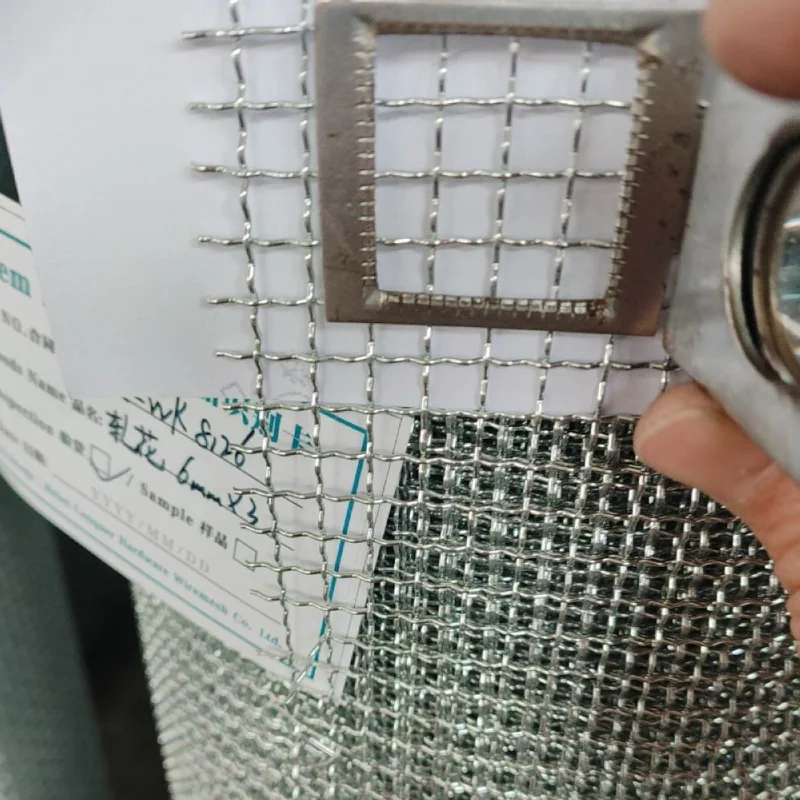 Crimped Wire Mesh
 Wire Mesh Products
 Wire Mesh RFQ Specification Builder
 Wire Mesh Weight Calculator