
Security Fence Project RFQ Questions for Posts, Gates and Panels
Updated Jun 24, 2026
A practical RFQ guide for buyers preparing security fence project details, including layout, panels, posts, gates, accessories, coating, packing and site constraints.
Table of contents
A security fence project quotation is easier to compare when the buyer sends more than a total length and a panel name. The supplier needs to understand the layout, panel height, mesh type, post method, gates, corners, accessories, coating, packing and site constraints before the quotation can reflect the real supply package.
RFQ means request for quotation. For a security fence project, a good RFQ should help the supplier count components and understand the project assumptions. It should not be treated as an engineering design package. Wind load, structural calculations, local codes, installation responsibility and final site approval should remain with the buyer's project team, installer or engineer.
Use the questions below to prepare a clearer security fence RFQ before requesting prices for panels, posts, gates and accessories.

Start with a site plan, not only total meters
The first question is not "what is the price per meter?" The first question is what the fence line looks like.
A supplier can estimate a simple straight run more easily than a project with offsets, slopes, gate openings, short returns and many corners. A site plan does not need to be a perfect engineering drawing at the first RFQ stage, but it should show enough information for component counting.
Useful layout details include:
- total fence length by section, not only total meters;
- corner positions and direction changes;
- gate locations and opening width;
- fence ends that meet walls, buildings or existing structures;
- slopes, steps or elevation changes;
- areas where access roads, utilities or structures affect installation.
If the buyer only sends "500 meters of security fence," the quotation may need many assumptions. If the buyer sends a simple sketch with section lengths, corner points and gate openings, the supplier can separate line posts, corner posts, end posts and gate posts more clearly.

For related specification planning, see the security fence specification checklist.
Define panel height, mesh type and security level
Panel specification affects material cost, packing format and the project appearance. It also affects which posts, clips and accessories need to be quoted with the fence system.
Key questions include:
- What panel height is required?
- Is the project using V-bend welded mesh panels, flat double-wire panels, chain link fence, 358 anti-climb mesh or another fence type?
- What wire diameter and mesh opening are requested?
- Is the top edge flat, bent, spiked or prepared for extension arms?
- Are there different fence zones with different panel types or heights?
- Does the buyer have an approved sample, drawing or local specification sheet?
Security language should be handled carefully. Small mesh openings, heavier wire and anti-climb profiles can support a higher-security design, but they do not automatically prove compliance with a specific site requirement. If the project has local code, prison, utility, airport or data-center requirements, the buyer should provide the required standard or project specification instead of asking the supplier to guess.
For product-family context, buyers can review the wire mesh fence category before preparing the final RFQ.
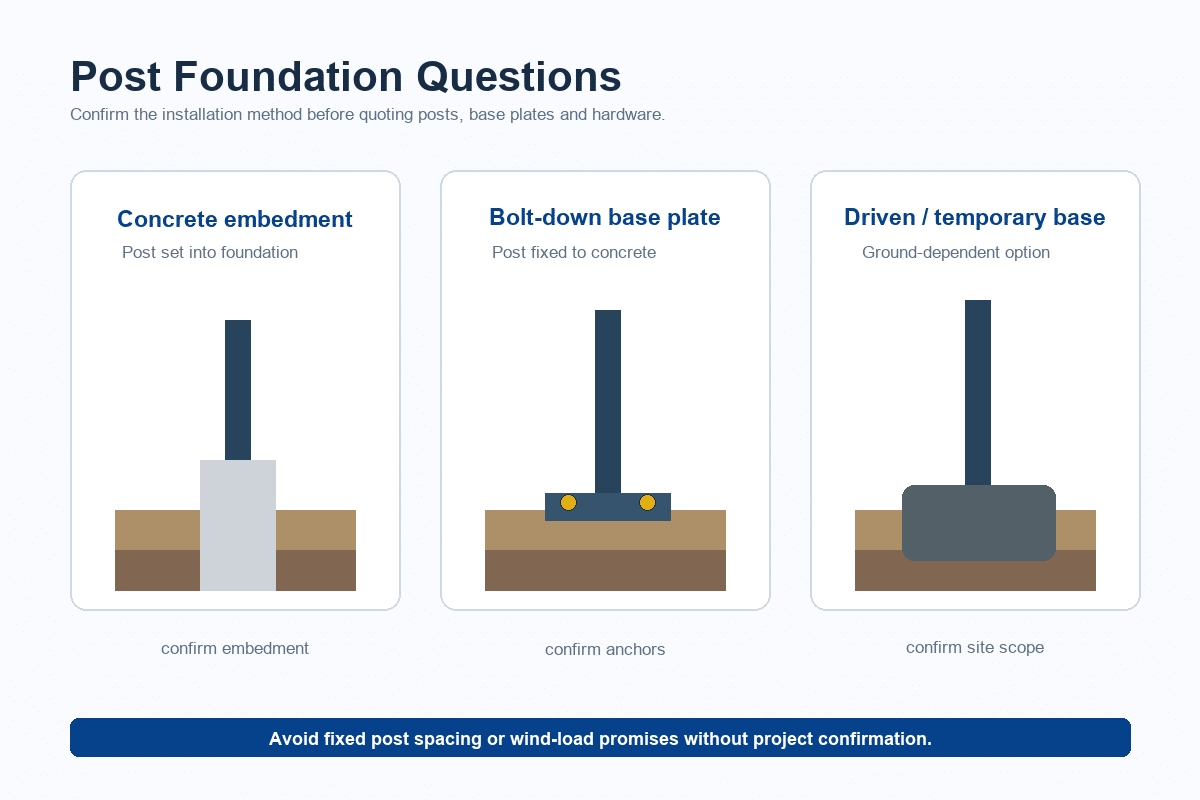
Clarify post type and foundation method
Posts often create quotation differences because they are affected by the panel system and the installation method. A fence quotation that says "posts included" may not be detailed enough for a project buyer.
Post questions to define include:
- square, round, peach, quick-mount or project-specific post profile;
- wall thickness or required post grade when specified;
- post length and visible height;
- concrete embedment, bolt-down base plate or other foundation method;
- base plate size and anchor scope if installed on existing concrete;
- line post, corner post, end post and gate post quantities;
- cap, bracket and bolt compatibility.
Post spacing should not be treated as a universal rule. It depends on panel width, post type, site exposure, installation method and local project requirements. The supplier can quote according to the buyer's requested panel width and post system, but the buyer's project team should confirm whether that setup is suitable for the site.

Separate gate details from the fence line
Gates should be listed as separate RFQ items. They are not simply another section of fence line because they include frames, hinge or sliding systems, posts, locks, stops and sometimes automation scope.
Gate questions include:
- How many pedestrian, vehicle or service gates are required?
- Is each gate swing, sliding, cantilever or another design?
- What is the clear opening width and gate height?
- Should the gate panel match the same mesh as the fence?
- Is the gate manual, prepared for automation or supplied with automation parts?
- Which hardware is included: hinges, latches, drop bolts, guide wheels, tracks, stops, lock boxes or padlock points?
- Are gate posts included in the gate item or counted separately?
If gate automation is involved, the RFQ should clearly state who supplies motors, sensors, control systems, wiring and installation. Many fence suppliers can quote the steel gate and hardware, while automation may need a separate local specialist depending on the project.
List corner posts, end posts and accessories
Corners, terminations and accessories often create missing-line-item issues. A clean RFQ separates the fence system into components so that both buyer and supplier can see what is included.
Common accessory questions include:
- Which bracket or clip system connects panels to posts?
- Are anti-tamper bolts or security fasteners required?
- Are post caps needed for all hollow posts?
- Are extension arms required for barbed wire or razor wire?
- Are bottom plates, base covers, clamps, U-bolts or special connectors included?
- Are spare clips, bolts or caps requested for site maintenance?
- Should accessories be packed by zone, gate set or SKU?
For accessories that affect security or installation, the buyer should not rely only on a photo. Ask for a list of accessory names, quantities and packing units so the receiving team can check them after delivery.
Specify coating, color and environment notes
Coating should cover the whole fence system, not only the panels. Posts, gate frames, brackets and accessories should be reviewed together so the finished project has consistent appearance and corrosion protection.
Useful coating questions include:
- Is the required finish hot-dip galvanized, galvanized plus powder coating, PVC coated or another finish?
- Is there a required color or RAL reference?
- Are panels, posts, gates and accessories using the same coating system?
- Is the site coastal, industrial, humid, high-UV or exposed to chemicals?
- Are coating test reports, sample panels or inspection photos required before shipment?
Avoid treating coating as a general promise. A coating system can be selected for a project environment, but expected service life depends on exposure, maintenance, installation damage and local conditions. If the project requires a specific coating standard or test result, the buyer should include that requirement in the RFQ.

Confirm packing, labels and shipment proof
Fence projects often ship as mixed packages: panels, posts, gates, accessories and sometimes barbed wire or razor wire. Packing instructions help the receiving team sort the goods when the container arrives.
Packing questions include:
- Are panels packed on pallets, in bundles or in frames?
- Are posts packed separately by length or type?
- Are gate sets packed with their matching hardware?
- Are accessories packed by SKU, by gate, or by project zone?
- Are private-label marks or buyer SKU labels required?
- Should loading photos show package sequence and container condition?
- Is the order full-container load or mixed with other products?
If the shipment includes several product lines, the packing list and package labels should use the same naming logic. The guide on mixed wire mesh container orders explains how labels, packing lists and receiving checks can stay aligned.

Ask site constraint questions early
Some quotation changes happen because site constraints were discovered after the price was prepared. These questions should be raised before the supplier finalizes panel, post and packing assumptions.
Site questions include:
- Is the site flat, sloped or stepped?
- Is the ground soil, rock, asphalt, existing concrete or mixed condition?
- Are underground cables, pipes or drainage lines near the fence line?
- Are there areas with limited access for delivery vehicles or unloading equipment?
- Does the site have high wind exposure or a local engineering requirement?
- Are there local rules for fence height, color, setback or visibility?
- Does the project need phased delivery by zone or gate opening?
The supplier can use this information to prepare a more practical quotation and to flag unclear points. The supplier should not replace the buyer's local installer, engineer or authority approval process.
Security fence RFQ field table
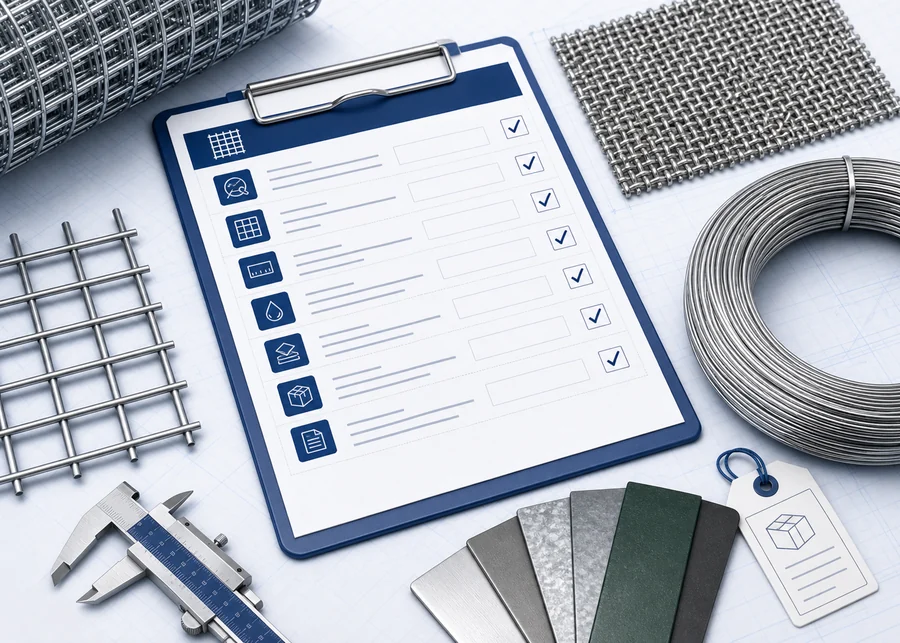
Use this table as a pre-RFQ checklist. It helps the buyer send the same information to every supplier and compare quotations on a similar basis.
| RFQ field | What the buyer should provide | How the supplier uses it | Risk if missing |
|---|---|---|---|
| Layout | Section lengths, corners, ends, gate openings and site sketch | Counts panels, line posts, corner posts and gate posts | Supplier quotes only a rough meter price |
| Panel specification | Height, mesh type, wire diameter, opening and top edge | Selects panel family and production route | Wrong panel type or under-defined security level |
| Post system | Profile, length, wall thickness and installation method | Prices posts, caps, brackets and base plates | Post cost or installation scope changes later |
| Gate details | Gate type, width, height, manual or automation scope | Prices gate frame, posts, hardware and packing | Gate is missing, underspecified or incompatible |
| Accessories | Clips, bolts, caps, extension arms, spare parts and special fasteners | Adds complete accessory package | Small items are missed during receiving |
| Coating | Finish, color, environment and document requirements | Plans galvanizing, powder coating or PVC coating route | Color or corrosion expectations are unclear |
| Packing | Pallet, bundle, label, SKU and loading proof requirements | Plans packing cost and shipment record | Receiving team cannot sort packages easily |
| Site constraints | Ground condition, slope, access, utilities and local requirements | Flags assumptions and quotation limitations | Project discovers changes after order confirmation |
What a quote-ready RFQ package can include
A complete RFQ does not need to be complicated. For many security fence projects, the buyer can send a compact package with:
- site sketch or drawing with fence line dimensions;
- required panel height and mesh type;
- post type and installation method;
- gate schedule with opening width and hardware notes;
- corner, end and gate post count if already known;
- accessory requirements;
- coating and color requirement;
- packing and label requirements;
- destination port and shipment timing target;
- local rules or engineering notes that the supplier should be aware of.
This information helps the supplier return a quotation with fewer hidden assumptions. It also gives the buyer a clearer way to compare prices, packing plans and open technical questions.
Frequently asked questions
What is the minimum information needed for a security fence RFQ?
At minimum, provide total length by section, panel height, mesh type, post installation method, gate openings and coating preference. A site sketch, even a simple one, makes the quotation more useful because it shows corners, ends and gate positions.
Should gates be included in the same RFQ as panels and posts?
Yes. Gates should be included in the same RFQ so the supplier can match gate height, mesh infill, coating, posts and hardware with the fence system. Gate automation scope should be stated separately because it may involve local electrical and control requirements.
Can a supplier decide post spacing for the buyer?
A supplier can quote according to the requested panel width and post system, but final post spacing should be checked against site conditions, installation method and any project engineering requirements. Avoid treating one spacing rule as universal for every security fence project.
What site information matters most before quotation?
The most useful site information is the fence layout, ground condition, slopes, underground utilities, gate openings, access limitations and any local rule for height, color or setback. These details help the supplier identify assumptions before the buyer compares quotations.
Are 358 anti-climb panels always required for security fencing?
No. Some projects use 358 mesh because the small openings support anti-climb requirements, but other projects may use V-bend welded panels, double-wire panels or chain link fence depending on the risk level, budget and local specification. The buyer should match the panel type to the project requirement.
What should be checked before approving the final quotation?
Check whether the quotation separates panels, posts, gates, accessories, coating, packing and documents. Also confirm which items are excluded, which dimensions are assumed and what information still needs project-side confirmation.
Prepare a quote-ready security fence inquiry
Before asking for a final price, prepare the layout, panel specification, post method, gate schedule, accessory list, coating requirement, packing rule and site notes. If some details are unknown, mark them as open questions instead of leaving them invisible.
ANJIA GROUP can review security fence project RFQ details for order-specific discussion. Send your layout, panel height, mesh type, post and gate requirements through the ANJIA inquiry page before the quotation is finalized.
About ANJIA GROUP
ANJIA GROUP supplies wire mesh, fencing and related industrial products for global B2B buyers. Contact our team to discuss product specifications, matching accessories and export packing.
Discuss your sourcing requirements
Send your product requirements and any relevant drawings to our team.
Get a Free Business Quote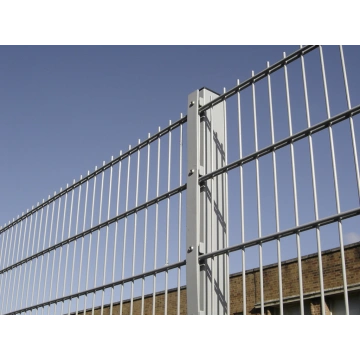 Wire Mesh and Fence Products
 Wire Mesh Products
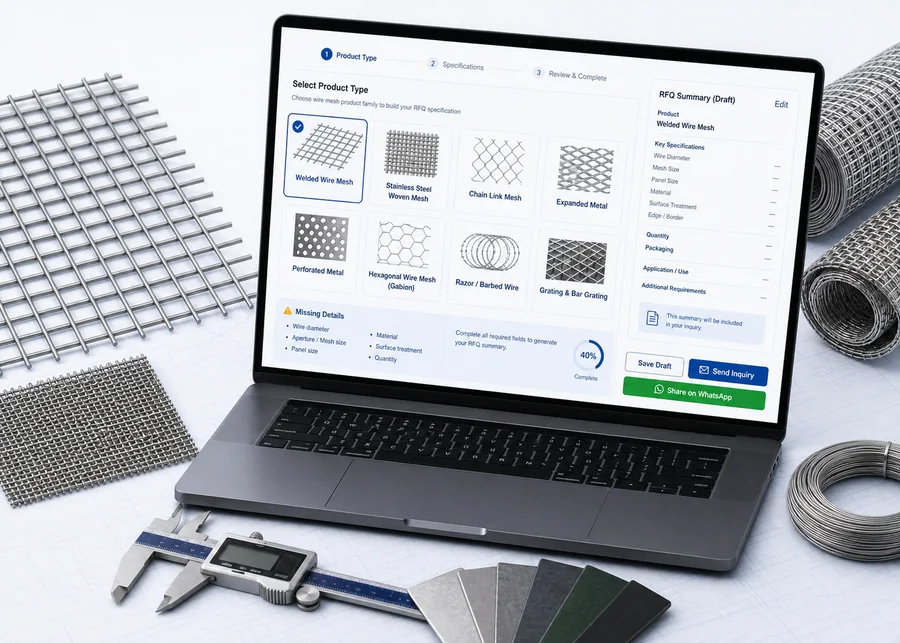 Wire Mesh RFQ Specification Builder
 Wire Mesh RFQ Checklist