
How to Read Wire Diameter and Mesh Opening QC Photos
Updated Jun 18, 2026
A practical guide for importers reviewing supplier QC photos for wire diameter, mesh opening, item ID cards, watermarks, sampling limits and packing proof.
Table of contents
Wire diameter and mesh opening photos are useful checkpoints in a wire mesh order, but they are not the whole inspection story. A clear photo can help a buyer confirm that the measured sample appears to match the purchase order. A poor photo can create more questions than answers.
For importers reviewing supplier updates, the goal is not to approve production from one close-up image. The goal is to understand what the photo can prove, what it cannot prove, and what follow-up questions should be asked before shipment. This is especially important when the order includes multiple specifications, mixed pallets or repeat shipments where small specification changes can affect receiving, cutting or installation.

1. Start by matching the photo to the order
Before reading the caliper or ruler, confirm that the photo belongs to the correct order. A measurement image without order context is only a generic factory photo.
A useful QC photo set should help the buyer identify:
- purchase order number, item code or project reference;
- product name and specification;
- material or surface treatment when relevant;
- production batch, roll, panel, pallet or sample reference when available;
- inspection date or photo date;
- the measurement point shown in the image.
If the photo does not show this context, ask the supplier to confirm it in writing. For repeat orders, this matters because an old photo from a similar item can look correct while not actually representing the current production run.
2. Read the wire diameter caliper photo
Wire diameter is one of the first items buyers check because it affects product weight, rigidity, quotation basis and product use. A good caliper photo should show the tool, the wire being measured and the reading clearly enough for the buyer to review.
Look for these details:
- the caliper jaws are closed on one wire, not across two wires or over a weld point;
- the measured wire is part of the correct mesh structure, not an edge wire from a different component;
- the display or scale is readable;
- the photo is sharp enough to see the contact point;
- the measurement is compared with the purchase order and agreed tolerance, not judged as a standalone number.
Do not treat one caliper photo as proof that every roll or panel has the same wire diameter. It shows one measured point. The buyer should compare it with the agreed specification and sampling plan, then ask for clarification if the reading appears outside the agreed range.
3. Check how the mesh opening is measured
Mesh opening photos help buyers confirm that the spacing between wires matches the order. For welded mesh, the photo should make it clear whether the supplier is measuring the clear opening, center-to-center spacing or another agreed basis. For woven or twisted products, the buyer should confirm the measurement method because the geometry may differ from square welded mesh.
Useful mesh opening photos usually show:
- a ruler, tape or caliper placed flat against the mesh;
- enough surrounding mesh to understand orientation;
- more than one opening when consistency needs to be checked;
- the direction being measured, such as width direction or length direction;
- a surface that allows the mesh to lie naturally without strong distortion.
If the ruler is at an angle, if the mesh is bent during the photo, or if the camera crops away the surrounding mesh, the image may not be enough for a decision. Ask for another photo before approving the checkpoint.

4. Use item ID cards to connect photos with samples
An item ID card turns a measurement photo into traceable documentation. It does not need to be complex, but it should connect the image to the order.
A practical item card may include:
- buyer item code or purchase order reference;
- product description;
- mesh opening and wire diameter specification;
- surface treatment or material reference;
- sample, pallet, roll or panel reference;
- date and inspector note when available.
The buyer should compare the card with the purchase order. If the card is missing, mismatched or too generic, the supplier may still be able to explain the photo, but the image is weaker as documentation.
5. Treat watermarks and timestamps as support, not proof
Watermarks, timestamps and order references can improve traceability. They make it easier to understand when a photo was taken and reduce the chance that an old stock photo is reused by mistake.
However, a watermark is not a quality certificate. It does not prove that the measurement method is correct or that the sample represents the full order. It simply adds context.
When reviewing watermarked QC photos, check whether:
- the date fits the production timeline;
- the photo background is consistent with the supplier's workshop or inspection area;
- the item card, label or order reference matches the current order;
- the same photo is not being reused for different items;
- sensitive commercial details are not unnecessarily exposed.
If the shipment is important or the specification is tight, watermarked photos should be used together with an inspection report, production records or third-party inspection when agreed in the contract.
6. Understand sampling limits
QC photos show selected samples. They do not show every roll, panel or carton. This is why buyers should agree on the sampling plan before production or before final inspection.
The sampling discussion should cover:
- which items or specifications need measurement photos;
- where samples are taken from in the production or packing flow;
- whether photos should show beginning, middle and end of production when relevant;
- how many sample points are expected for each item;
- whether the buyer needs a summary table in addition to photos;
- who decides follow-up action if a reading is unclear or outside the agreed range.
Avoid vague requests such as "send QC photos." A better request is to define the photo types: wire diameter, mesh opening, surface condition, label, packing and loading proof. For broader supplier-proof context, buyers can also review how factory video references are used in wire mesh sourcing in our factory video guide.
7. Compare photos with records and packing proof
Measurement photos are strongest when they are part of a complete pre-shipment record. The buyer should compare photos with the quotation, purchase order, production notes and packing photos.
For example:
- wire diameter photos should match the item specification;
- mesh opening photos should match the ordered opening and measurement basis;
- item cards should match the purchase order;
- labels should match the packing list or buyer item codes;
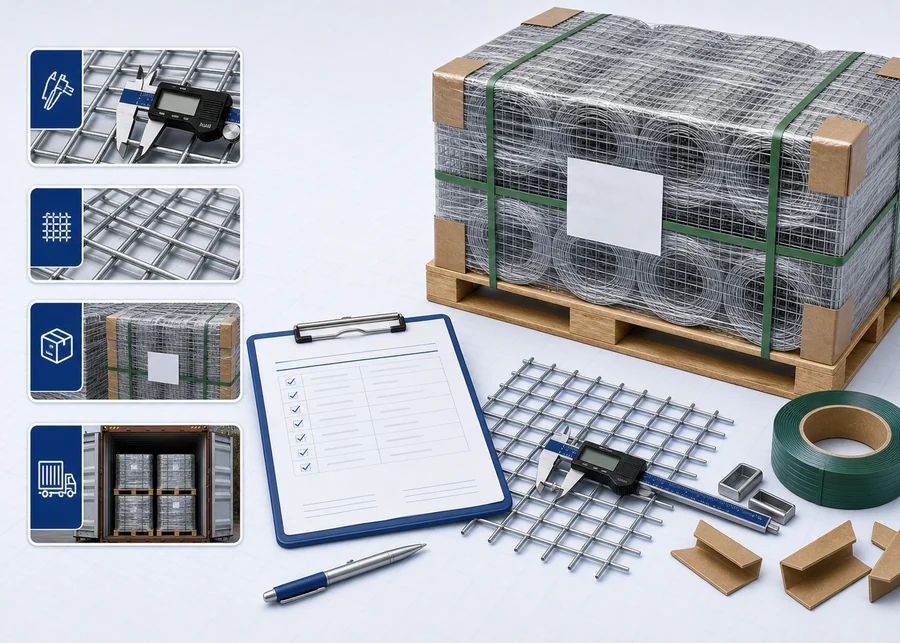
- packing photos should show the goods prepared for shipment, not only samples on a table.
If there is a mismatch, ask the supplier to explain it before shipment. It is easier to correct a wrong label, unclear sample photo or mixed specification before loading than after destination receiving. For related shipment-proof checks, see our guide to wire mesh export packing photos.

QC photo review checklist
| Photo type | What to check | Follow-up question |
|---|---|---|
| Wire diameter caliper photo | Tool contact, readable display, correct wire position | Is this reading within the agreed tolerance for this item? |
| Mesh opening photo | Measurement basis, ruler position, surrounding mesh context | Is the opening measured by the method stated in the order? |
| Item ID card | PO, item code, product description and date | Does this card match the current order and sample? |
| Watermark or timestamp | Date, order reference and consistency | Was this photo taken for this production batch? |
| Surface overview | Coating, welds, weave and visible damage | Are any defects limited to one sample or repeated? |
| Packing photo | Labels, pallet condition, carton or roll protection | Do the packing photos match the packing list and buyer marks? |
| Summary record | Measurement values, sample reference and inspector note | Is there a written record behind the photo set? |
8. Ask for clarification before approval
If a photo is unclear, do not approve the checkpoint simply to keep the shipment moving. Ask for a repeat photo, a wider angle, a different measurement point or a short written explanation.
Useful clarification requests include:
- "Please resend the caliper photo with the display and wire contact point in focus."
- "Please show the item card beside the sample."
- "Please confirm whether the mesh opening is measured clear opening or center-to-center."
- "Please provide a summary table for the measured samples."
- "Please add packing and label photos before loading."
Clear questions help both sides. The buyer gets a better record, and the supplier understands exactly what is needed before shipment approval.
FAQ
Can QC photos replace formal inspection?
No. QC photos are useful supporting evidence, but they do not replace an agreed inspection report, buyer inspection or third-party pre-shipment inspection when those are required. Photos show selected points at a specific time.
What should I do if a caliper reading looks different from the order?
Ask the supplier to confirm the item, sample point, measurement method and agreed tolerance. Request a repeat photo or additional samples if needed. Do not make a final decision from one unclear image.
Should every photo include an item ID card?
For important measurement photos, yes whenever practical. An item card helps connect the image to the purchase order, specification and batch. For wider workshop or packing photos, the order reference may appear through labels or a summary record instead.
Are watermarked photos always better?
They are helpful, but not sufficient by themselves. A watermark or timestamp adds traceability, but the measurement method, sample selection and order match still need to be checked.
Can ANJIA prepare QC photo requirements before quotation?
ANJIA GROUP can review wire mesh specifications, measurement-photo needs, packing proof and shipment documentation requirements according to the order. Buyers can send product type, wire diameter, mesh opening, surface treatment, quantity, packing preference and destination through the inquiry page.
Build QC photos into the sourcing process
Wire diameter and mesh opening photos work best when they are planned before production, not requested in a hurry before loading. Add the required photo types, item references and sampling expectations to the quotation or purchase order. Then review the final photo set against the same checklist.
This process helps buyers avoid unclear approvals and gives suppliers a practical documentation standard. If you are still comparing product types or preparing an RFQ, start from the wire mesh buying guides or send your specification to ANJIA GROUP for review.
About ANJIA GROUP
ANJIA GROUP supplies wire mesh, fencing and related industrial products for global B2B buyers. Contact our team to discuss product specifications, matching accessories and export packing.
Discuss your sourcing requirements
Send your product requirements and any relevant drawings to our team.
Get a Free Business Quote Wire Mesh and Fence Products
 Wire Mesh Products
 Factory, QC & Packing Reference Pack
 Wire Mesh RFQ Checklist