
Mixed Wire Mesh Container Orders: Packing List, Labels and Accessory Control
Updated Jun 23, 2026
A practical checklist for importers consolidating mixed wire mesh and fence products in one container, covering packing lists, SKU labels, accessory control and loading photos.
Table of contents
Importers often combine several wire mesh and fencing products in one shipment. A mixed container may include welded mesh rolls, panel stacks, rolled mesh, temporary fence components, posts, fasteners or accessory cartons in the same loading plan. Consolidation can be useful, but it also creates more packing, labeling and receiving work than a single-product order.
The main risk is not only transport damage. The larger issue is receiving confusion: similar cartons without clear SKU marks, accessory bags separated from the main order, or a packing list that does not match the physical package labels. These problems are easier to prevent before loading than to solve after the container arrives.
This checklist explains how importers can review mixed wire mesh container orders, including packing list alignment, SKU labels, accessory control, pallet grouping, loading photos and destination warehouse checks.

Start with a packing list that matches the purchase order
For a mixed container order, the packing list is the bridge between the purchase order and the physical shipment. It should show which product is packed, how many packages are included, and how each package can be identified during unloading.
Before final packing, the buyer should compare the draft packing list with the purchase order. The key checks include:
- Every purchase order line appears on the packing list.
- Product name, specification, quantity and unit are consistent.
- Package type is clear, such as roll, carton, pallet or bundle.
- Gross weight, net weight and package dimensions are filled where needed.
- Package numbers are assigned in a way that can be matched to physical labels.
- Container number and seal number are added after loading when available.
If several products look similar, the packing list should not rely only on general descriptions such as "wire mesh" or "fence accessories." It should separate SKUs by product type, size, coating, width, length, panel height or accessory type. This helps the receiving team compare the documents with the goods without opening every package.
Use SKU labels that warehouse teams can read
In a mixed shipment, SKU labels are the fastest way to separate products after arrival. The label does not need to expose private customer information in public photos, but the actual shipment label should be clear enough for the buyer's receiving team.
A practical SKU label may include:
- Importer's SKU or item code.
- Short product name.
- Key specification, such as mesh opening, wire diameter, coating, panel size or roll size.
- Quantity per package.
- Package number or pallet number.
- Purchase order or receiving reference when the buyer requires it.
Label placement also matters. Labels should be applied in a consistent position on each pallet, carton, roll bundle or accessory bag. If some labels are placed under wrapping film and others are hidden on the back side, the receiving team may lose time locating them.
For distributor or private-label programs, label artwork and SKU format should be confirmed before packing starts. The related guide on private label wire mesh orders explains how label artwork, carton marks and SKU records can be controlled without exposing private buyer data in public images.

Keep accessories visible and counted
Mixed wire mesh orders often include small items that are easy to misplace: clips, caps, fasteners, lacing wire, tie wire, tension bars, C-rings, tools or small cartons. These items should not be treated as an afterthought.
The safer method is to give accessories their own packing line and physical label. If an accessory belongs to a fence panel order, the packing list can still show it as a separate line item or sub-line with its own package number. This makes it easier to confirm whether the accessory package was loaded and received.
For accessory control, buyers can ask the supplier to confirm:
- Accessory type, specification and quantity.
- Whether accessories are packed in bags, cartons or on a small pallet.
- How accessory packages are labeled.
- Where accessories are placed in the loading sequence.
- Whether an accessory grouping photo will be provided before loading.
If accessories are packed inside a larger pallet, the outer label should say so. Otherwise, the receiving team may assume the accessory package is missing when it is only hidden inside another wrapped package.

Group pallets by SKU and unloading priority
Pallet grouping affects both loading control and unloading efficiency. When several SKUs are shipped together, products of the same SKU should be grouped together where practical, or placed in adjacent positions with clear labels.
This is especially important when a container includes heavy rolled mesh, palletized panels and smaller accessory cartons. The supplier should consider weight, product shape, surface protection and unloading sequence instead of only filling space.
A simple grouping review should cover:
| Control point | What to confirm | Why it helps |
|---|---|---|
| Same-SKU grouping | Similar products are grouped on the same pallet or adjacent pallets | Reduces sorting work at receiving |
| Heavy and light items | Heavy rolls or bundles do not crush smaller cartons | Reduces packing damage risk |
| Coating-sensitive products | PVC-coated or powder-coated goods have suitable separation | Helps protect visible surfaces |
| Accessory position | Small cartons or bags are visible or clearly marked | Prevents missing-accessory confusion |
| Unloading priority | Items needed first are placed near the door when practical | Helps warehouse or project-site receiving |
The loading plan does not need to be complicated, but it should be clear. Buyers can request a short note or photo set explaining how products are grouped before the container is closed.
Review packing and loading photos before the container leaves
Packing photos are useful because label and grouping issues are easier to correct before the container leaves the factory. They should support the packing review, not replace formal inspection or order-specific QC records.
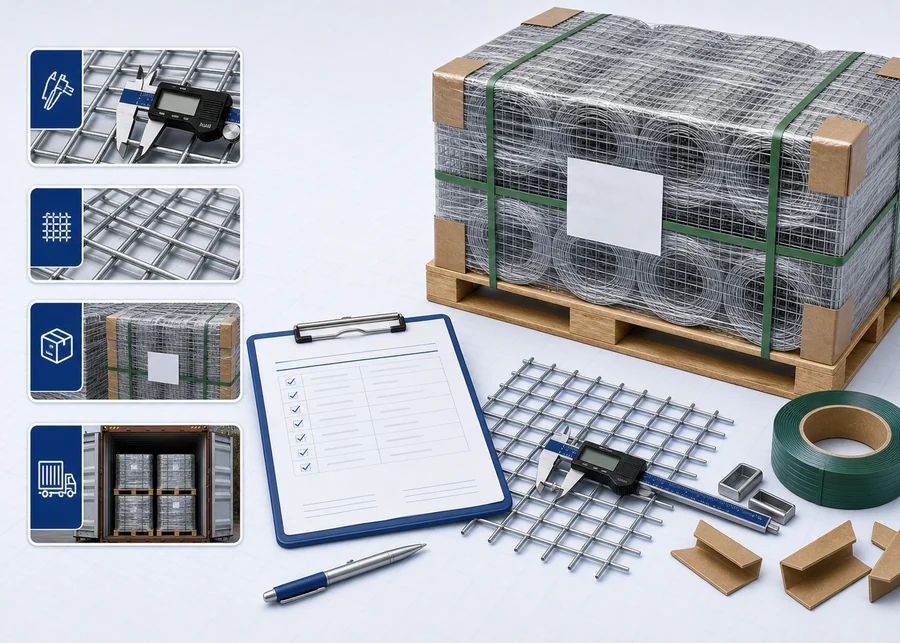
For a mixed wire mesh container, a practical photo set may include:
- One label close-up for each important SKU.
- Pallet overview photos showing product grouping.
- Accessory package or accessory pallet photo.
- Loading sequence photos from the container door.
- Final container door photo with seal information when available.
The guide on wire mesh container loading photos explains what buyers can check at the loading stage. For earlier order follow-up, production photo updates can help the buyer understand progress before final packing.
Photos should be handled carefully. Public website images should not expose customer names, consignee details, complete purchase order numbers, barcode values or confidential shipping marks. If a label photo is needed for marketing or review examples, sensitive fields should be hidden or replaced with neutral information.
Proof-ready answer: For mixed wire mesh containers, the safest release record connects the packing list, SKU labels, accessory cartons, pallet grouping and final loading photos. This proof helps the receiving team identify what arrived, but it cannot replace a formal inspection, a buyer-approved label file or the commercial documents required for customs and accounting.

Prepare the receiving team before arrival
Mixed container control does not end after loading. The receiving warehouse should know what to expect before the container arrives. The buyer can share the packing list, loading photos and any SKU map with the warehouse team so they can unload systematically.
Useful receiving checks include:
- Confirm the container seal number against shipping documents when applicable.
- Count total pallets, rolls, cartons and bundles before moving goods into storage.
- Compare package numbers with the packing list.
- Spot-check SKU labels against the product inside selected packages.
- Count accessory cartons or bags separately.
- Photograph visible damage, shifted packages or label problems before unpacking.
- Record shortage or discrepancy notes while the goods are still in the receiving area.
If a warehouse team starts moving goods into different storage zones before counting and label checks, missing accessories or mixed SKUs become harder to trace later. A receiving checklist based on the supplier's packing list gives the team a practical way to close the loop.
Mixed container order vs single-product order
| Control point | Mixed container order | Single-product order |
|---|---|---|
| Packing list | Multiple SKUs need separate lines, package numbers and label matching | Usually fewer line items and simpler package matching |
| SKU labels | Each product line needs its own readable label | One label format may cover most packages |
| Accessory handling | Small items need separate count and visible grouping | Accessories may be easier to link to one product |
| Pallet grouping | Products should be grouped by SKU, weight and unloading priority | Pallet layout is usually more uniform |
| Photo review | Requires label, pallet, accessory and loading sequence photos | Often focuses on packing condition and loading overview |
| Receiving process | Warehouse checks SKU by SKU and counts accessories separately | Receiving can often count one product type |
| Error risk | Higher if labels, package numbers or accessories are unclear | Lower because product variation is limited |
| Coordination | May require more packing-list and workshop coordination | Usually follows a simpler packing workflow |
Questions to ask before placing a mixed container order
Before confirming a mixed wire mesh order, importers can ask a short set of practical questions:
- Can each SKU be shown as a separate packing-list line?
- What package number format will be used for pallets, rolls, cartons or bundles?
- Where will SKU labels be placed on each package type?
- How will accessory bags or small cartons be labeled and grouped?
- Can the supplier provide a pallet grouping photo before loading?
- Which loading photos will be sent before the container is sealed?
- Can photos hide private buyer data when used for public or internal presentation?
- What receiving checklist should the warehouse use when the container arrives?
These questions help both sides align the physical shipment with the documents before goods leave the factory.
Frequently asked questions
What should be included in a mixed wire mesh container packing list?
The packing list should separate each product or SKU by line item and show specification, quantity, package type, gross weight, net weight, dimensions and package number where applicable. It should also match the physical labels used on pallets, rolls, cartons or bundles.
How should accessories be handled in a mixed container?
Accessories should be counted, labeled and listed clearly. Small items can be packed in bags, cartons or a dedicated pallet, but the packing list and package label should make their location clear. If accessories are placed inside a larger package, the outer label should mention that detail.
Are packing photos enough to confirm a mixed shipment?
No. Packing photos help review visible labels, pallet grouping and loading sequence, but they do not replace inspection, product testing or order-specific QC records when those are required. Photos should be used together with the packing list and agreed QC process.
Can different product types be loaded in one container?
Yes, different wire mesh or fence products can be consolidated when the order plan supports it. The key is to separate SKUs, protect surfaces, manage weight distribution and keep labels readable. Buyers should confirm this during order review rather than waiting until loading day.
How can importers reduce receiving confusion?
Importers can use separate SKU labels, clear package numbers, accessory grouping, loading photos and a receiving checklist. The receiving team should count packages and compare labels with the packing list before goods are moved into long-term storage.
When should a buyer send packing-label requirements?
Packing-label requirements should be sent before packing materials are prepared. For repeat orders, the buyer should also confirm whether the previous label version, SKU list and packing format are still valid.
Prepare a mixed container order request
A clear mixed container request should include product specifications, SKU list, packing list format, label requirements, accessory details, photo checklist and unloading priority if needed. Buyers can also share previous shipment photos if they want the next shipment to follow a similar receiving workflow.
ANJIA GROUP can review wire mesh, welded wire mesh and related product requirements for mixed shipment planning. When the order details are ready, send the specification list through the ANJIA inquiry page for order-specific review.
About ANJIA GROUP
ANJIA GROUP supplies wire mesh, fencing and related industrial products for global B2B buyers. Contact our team to discuss product specifications, matching accessories and export packing.
Discuss your sourcing requirements
Send your product requirements and any relevant drawings to our team.
Get a Free Business Quote Wire Mesh and Fence Products
 Wire Mesh Products
 Factory, QC & Packing Reference Pack
 Wire Mesh RFQ Checklist