Peruvian Buyer Visits ANJIA’s Anping Manufacturing Base for Factory Review and Supply Cooperation
Updated Aug 28, 2026
During a recent visit to ANJIA's Anping manufacturing base, a buyer from Peru reviewed the factory environment, exchanged technical information and discussed future supply cooperation.
Table of contents
ANJIA recently welcomed a buyer from Peru to our manufacturing base in Anping County, Hebei. The visit created an opportunity for both teams to review the factory environment, discuss how technical and export requirements are communicated, and explore a foundation for future supply cooperation. Our conversations covered supplier evaluation, production coordination, quality documentation, export packing and the information a buyer needs before moving a commercial discussion forward. To respect customer confidentiality, this update does not identify the visitor's company or disclose any inquiry, quotation, purchase plan or transaction detail. After the visit report, we provide a separate overview of several wire mesh and hardware categories relevant to the Peru market, together with the specification fields and technical references that buyers may need. Those market examples are general sourcing guidance and should not be read as the visitor's purchasing information.

A factory visit built around mutual understanding
The visitor travelled to Anping to gain a clearer view of ANJIA's manufacturing support and export communication process. ANJIA GROUP is supported by Hebei Conquer Hardware Wire Mesh Co., Ltd., our manufacturing backbone in Anping County. This relationship is explained on the About ANJIA page and is visible in the group photograph taken at the manufacturing base.
Our team introduced the working environment and explained the general process used to receive and manage overseas requirements. The discussion focused on communication discipline, quality-record handling, packing coordination and the working method both sides could use if cooperation advances.
The meeting also allowed both teams to discuss communication expectations. For a buyer in Peru, the ability to clarify Spanish and English business and technical terminology, confirm measurement units and keep consistent wording across working documents can be important to an efficient cooperation process.

What can an international buyer review during an ANJIA factory visit?
A productive visit should help the buyer understand how the supplier handles information as well as products. The review can be adapted to the visitor's industry and sourcing stage without disclosing confidential commercial plans.
| Factory-review area | What the buyer can discuss | Useful follow-up material |
|---|---|---|
| Manufacturing scope | Which product families and processes are relevant to the buyer's market | Product list, application summary and reference photographs |
| Specification handling | How openings, wire diameters, materials, finishes and dimensions are recorded | Drawing, sample, datasheet or buyer specification |
| Quality communication | Which measurements, photographs, reports or third-party checks may be requested | Inspection checklist and acceptance points |
| Packing and identification | How rolls, coils, panels, bundles or cartons should be protected and labelled | Packing instruction, label content and receiving requirements |
| Export coordination | How destination, document requests and shipment preparation are communicated | Destination, consignee requirements and document list |
The goal is to create a common working method. A factory visit does not replace a final specification, approved sample, signed contract or inspection plan. It helps both teams identify which information still needs to be confirmed before those formal steps.
Why Peru is an important South American market for ANJIA
ANJIA treats Peru as an important market in its South American business development. Wire mesh and metal hardware can serve many different purchasing contexts, including construction supply, industrial screening, agricultural use, property protection, hardware distribution and project-based fencing.
Peru is also a market where terminology matters. Buyers and distributors may search or write specifications using Spanish terms such as malla de acero inoxidable, malla electrosoldada, cerca de seguridad, malla ciclónica, alambre galvanizado and clavos galvanizados. An export supplier should be able to connect those commercial terms with measurable product fields rather than translating a product name word for word and assuming the specification.
The following product overview is market-level sourcing information. It is separate from the customer visit described above and does not disclose what the visitor discussed, requested or purchased.
Wire mesh and hardware categories relevant to the Peru market
Stainless steel wire mesh
Stainless steel wire mesh can be considered for industrial screening, filtration, ventilation, protection and other application-specific uses. A Peru RFQ may use the term malla de acero inoxidable, but the material name alone is incomplete.
The buyer should state the stainless steel grade, weave type, mesh count or clear opening, wire diameter, roll or sheet dimensions, edge treatment and required inspection method. For industrial woven wire cloth, ASTM E2016-22 is one possible technical reference when it is explicitly required by the buyer or project.
Welded wire mesh and PVC-coated welded mesh
Welded wire mesh is supplied in rolls or panels for different construction, enclosure, agricultural and general-purpose applications. Common Spanish descriptions include malla electrosoldada, malla electrosoldada galvanizada and malla electrosoldada plastificada.
An RFQ should separate mesh opening, wire diameter, roll or panel width, length, surface treatment, PVC colour where applicable, edge condition, unit weight, quantity and packing. If the product is welded wire reinforcement for concrete, ASTM A1064/A1064M-24 may be relevant when specified. That concrete-reinforcement standard should not be applied automatically to general-purpose PVC-coated or galvanized roll mesh.
The following PVC welded wire mesh configurations are standalone Peru-market RFQ examples. They do not describe the visitor's inquiry, purchase or order. Roll width, PVC colour, coating thickness, tolerance and purchasing quantity would still need to be confirmed separately.
| Mesh opening | Wire diameter | Roll length | Reference roll weight |
|---|---|---|---|
| 1/2 in × 1/2 in | 0.9 mm | 30 m/roll | 9 kg/roll |
| 1/2 in × 1/2 in | 0.9 mm | 30 m/roll | 18 kg/roll |
| 3/8 in × 3/8 in | 0.9 mm | 30 m/roll | 18 kg/roll |
| 1/2 in × 1/2 in | 0.9 mm | 30 m/roll | 23 kg/roll |
| 3/8 in × 3/8 in | 0.9 mm | 30 m/roll | 23 kg/roll |
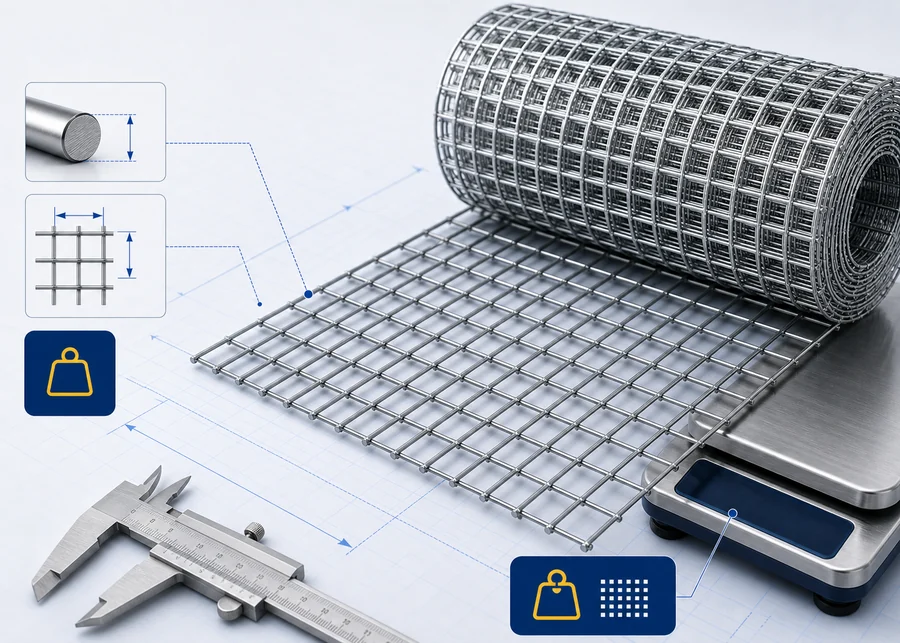
The different roll weights show why buyers should not compare PVC welded mesh by opening, wire diameter and roll length alone. Roll width and the complete coating specification are needed before weight can be used as a quotation or receiving cross-check.

Security fencing and chain-link systems
Security fencing is a system rather than a mesh roll alone. Peru buyers evaluating cerca de seguridad or malla ciclónica should identify the required fence type, mesh or panel dimensions, wire diameter, height, coating, posts, rails, fittings, gates and installation environment.
For galvanized chain-link fabric, an order may refer to ASTM A392 when the project requires it. Polymer-coated chain-link fabric may refer to ASTM F668. The applicable edition, coating class and complete fence-system requirement should appear in the buyer's project documents; naming one standard does not define posts, gates, fittings or installation by itself.
Galvanized iron wire
Galvanized iron wire may be requested for tying, fabrication, mesh production, agricultural work and other buyer-defined uses. The RFQ should include wire diameter in millimetres or a clearly identified gauge system, hot-dip or electro-galvanized finish, zinc coating mass, tensile or softness requirement, coil weight, total quantity and packing.
ASTM A641/A641M-19(2025) covers zinc-coated carbon steel wire in coils for general use. It distinguishes coating requirements and wire temper, which is why a buyer should not use “galvanized wire” as the only technical description.
These general galvanized wire configurations illustrate how gauge, coil weight and zinc coating mass can be separated in a Peru-market RFQ. They are product reference data only and are not associated with the customer visit.
| Gauge reference | Coil weight | Zinc coating mass reference |
|---|---|---|
| BW 12 | 50 kg/coil | 30–50 g/m² |
| BW 14 | 50 kg/coil | 30–50 g/m² |
| BW 16 | 50 kg/coil | 30–50 g/m² |
| BW 18 | 25 kg/coil | 20–30 g/m² |
| BW 20 | 25 kg/coil | 20–30 g/m² |
| BW 22 | 25 kg/coil | Buyer must specify; do not assume a range |
For a new request, the gauge convention should also be paired with a diameter in millimetres when possible. Softness or tensile requirement, coil wrapping, labels and total purchasing quantity remain separate buyer-defined fields.

Roofing nails and general hardware fasteners
Peru hardware buyers may evaluate galvanized nails, common nails or roofing fasteners alongside wire and mesh products. A complete nail RFQ should state length, shank diameter or gauge, head type, smooth or deformed shank, point, washer requirement, surface finish, weight or count per carton, carton marking and total quantity.
ASTM F1667/F1667M-21a is a reference for driven fasteners, including nails, spikes and staples, when a contract calls for it. The buyer should still identify the exact nail style and protective finish instead of treating the standard designation as a complete product description.
One general roofing-nail configuration that may be written into a Peru-market product sheet is shown below. It is an independent product example and is not information about the visitor's commercial activity.
| Nail length | Shank gauge | Head and shank | Washer | Surface finish | Packing unit |
|---|---|---|---|---|---|
| 2½ in | BWG9 | Umbrella head, twisted shank | Rubber washer | Electro-galvanized | 25 kg/carton |
Other nail sizes, gauges, head forms, washers, finishes and carton units should be written as separate configurations. Total carton quantity is a confidential commercial field and is not included in this market example.
Key specification fields for a Peru sourcing request
The table below summarizes the information that normally needs to be defined. These are general RFQ fields, not specifications associated with the visitor in this company update.
| Product direction | Product identity fields | Dimensions and material | Finish and packing |
|---|---|---|---|
| Stainless steel wire mesh | Weave type and intended use | Grade, mesh count or opening, wire diameter, width and length | Edge treatment, roll or sheet packing, inspection request |
| Welded wire mesh | Roll or panel; general mesh or concrete reinforcement | Opening, wire diameter, width, length and unit weight | Galvanized/PVC finish, colour, edge condition and packing |
| Security fence | Chain link, welded panel or another defined system | Mesh/panel size, wire diameter, fence height, posts and gates | Coating class, fittings, bundle/pallet plan and installation environment |
| Galvanized wire | Intended use and gauge convention | Diameter, tensile/softness requirement and coil weight | Galvanizing process, zinc coating mass, coil wrapping and labels |
| Nails and fasteners | Nail style, head, shank, point and washer | Length, diameter/gauge and material | Finish, carton weight/count, markings and pallet plan |
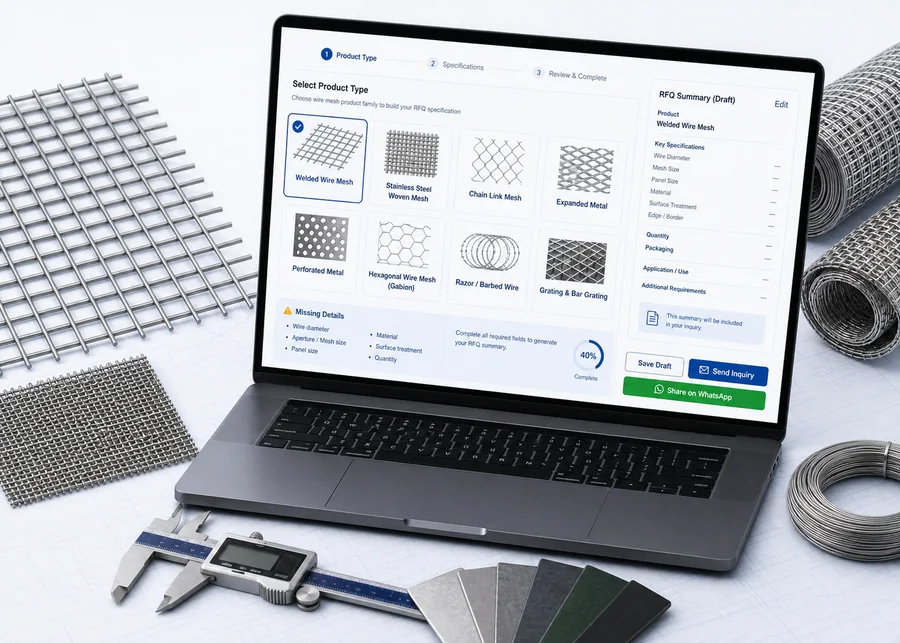
Buyers can use the wire mesh RFQ checklist to organize these fields before sending a drawing or specification file.
How technical standards should be handled for Peru projects
There is no single technical standard that automatically covers every wire mesh, fence, wire and fastener purchase for Peru. The correct requirement may come from a Peruvian regulation, a Norma Técnica Peruana, an international standard, a project drawing or the buyer's own purchasing specification.
Peru's Instituto Nacional de Calidad, INACAL, publishes information about Normas Técnicas Peruanas and maintains a current list of standards referenced in mandatory provisions. The buyer, designer or project authority should confirm whether a particular NTP is applicable and which edition controls the purchase.
When ASTM or another international reference is requested, the RFQ should name the full designation and edition, then add the product-specific dimensions, coating, testing and acceptance requirements. Standards support a specification; they do not replace it.
From factory dialogue to responsible cooperation
The Peru visit gave both teams time to understand each other's working methods and discuss how a future cooperation process could be organized. For ANJIA, responsible international business also means respecting what should remain private. Customer identity, commercial plans, quotations and transaction information are not part of this public report.
What we can share is our approach: prepare a focused visit agenda, discuss product terminology and technical fields, identify the required quality evidence, and keep the same specification language through quotation, production review, packing and export coordination.

Arrange an ANJIA factory visit or discuss a Peru requirement
If your company is sourcing wire mesh, fencing, galvanized wire or hardware products for Peru, send us the product family, application, drawings or reference photos, required standard, dimensions, quantity, packing and destination. We can prepare a focused visit to the Anping manufacturing base or review the same information remotely.
Contact ANJIA through the inquiry page or email sales@anjiamesh.com. Commercial details will be handled as private buyer-supplier information.
About ANJIA GROUP
ANJIA GROUP supplies wire mesh, fencing and related industrial products for global B2B buyers. Contact our team to discuss product specifications, matching accessories and export packing.
Discuss your sourcing requirements
Send your product requirements and any relevant drawings to our team.
Get a Free Business Quote Wire Mesh Products
 Welded Wire Mesh
 Wire Mesh RFQ Specification Builder
 Wire Mesh Weight Calculator