
Wire Mesh Specification RFQ Fields: What Importers Should Include
Updated Jun 24, 2026
A practical RFQ field guide for importers defining mesh opening, wire diameter, unit weight, material, finish, format, quantity, packing and proof needs.
Table of contents
When an importer prepares a broad wire mesh RFQ, the main risk is not only receiving a high price. The bigger risk is comparing quotations that were built on different assumptions. One supplier may price a roll, another may assume panels. One may quote wire diameter before coating, another may read the finished diameter. Another may estimate weight from dimensions while the buyer already has a target weight from a previous order. A vague RFQ can make the first price look simple while creating problems later in sample review, production, packing and shipment.
Wire mesh specification RFQ fields help buyers make the request measurable before price comparison starts. The goal is not to force every product into one fixed template. It is to give the supplier enough clear information to quote the right product family, ask useful follow-up questions and avoid guessing about mesh opening, wire diameter, unit weight, material, finish, format, quantity and packing.
Use this guide as a practical field framework. For order-specific requirements, drawings, approved samples, inspection records and purchase documents should still control the final order.

Start with product format and application context
A wire mesh RFQ should begin with the product format because the same broad term can describe very different supply forms. Welded mesh rolls, welded mesh panels, woven mesh, hexagonal mesh, stainless steel mesh, fence mesh and cut-to-size sheets may all be called wire mesh in buyer messages, but the quotation fields are not identical.
Before listing dimensions, state the intended format:
- roll, panel, sheet or cut piece;
- approximate application or project use;
- indoor, outdoor, packing, enclosure, screening, fencing or industrial use;
- whether the request is for a standard product, sample, replacement item or custom project;
- quantity range and destination country or port.
This context helps the supplier decide which follow-up questions are necessary. Buyers can also use the wire mesh category page for product-family orientation before sending an inquiry.
Define mesh opening before discussing price
Mesh opening is one of the first fields that affects product use, weight and price. The problem is that buyers and suppliers may use different measurement language.

Common ways to describe the opening include:
- clear opening: the open space between two adjacent wire edges;
- center-to-center spacing: the distance from the center of one wire to the center of the next wire;
- mesh count: the number of openings per linear inch, often used for finer woven or screen products.
In the RFQ, write the measurement method whenever it matters. A message that says "50 mm opening, clear opening" is safer than "50 mm mesh" if the product must match a drawing or installation requirement. If the buyer is matching an existing sample, attach a close photo with a ruler or caliper reference.
State wire diameter and whether it is before or after coating
Wire diameter affects strength, weight, handling, packing and material consumption. It should not be left as a vague gauge number unless both sides use the same gauge reference.

For most RFQs, buyers should state:
- wire diameter in millimetres where possible;
- whether the diameter is measured before coating or after coating;
- whether the same diameter applies to all wires;
- whether the diameter should be checked against a drawing, sample or inspection method;
- whether the buyer will accept an alternative diameter proposal.
For shipment release and QC review, the guide on wire diameter and mesh opening QC photos explains how buyers can read measurement photos without treating photos as a full inspection report.
Use unit weight as a cost and specification cross-check
Wire mesh is mainly priced from metal material, so weight is one of the most useful quotation fields. When the buyer knows the unit weight, historical shipment weight or target weight, the supplier can check whether the requested mesh opening, wire diameter, size and finish are realistic for the expected product.
Useful weight fields include:
- net weight per roll, panel, sheet or square metre;
- gross weight per package or pallet, if packing is already known;
- total shipment weight from a previous order;
- target weight based on the buyer's existing product or local market requirement;
- whether the weight is before packing or includes packing materials.
Weight is especially helpful when the buyer has product dimensions but is unsure about wire diameter. With size and target weight, the supplier can estimate a more practical wire diameter range and identify whether the RFQ is likely too light, too heavy or missing a coating assumption. If the buyer cannot provide weight, the supplier can still estimate it from confirmed mesh opening, wire diameter, material, finish, size and quantity, but the quotation may need more confirmation before production.
Before shipment, weight can also support final release checks. For ANJIA order follow-up, prepared goods or packages can be weighed when required for the order, and weight records or weighing photos can be shared with the buyer together with packing or loading proof. This does not replace inspection, but it helps confirm that the shipped goods are consistent with the agreed specification and packing list.
Separate material from surface finish
Material and finish should be written as two separate RFQ fields. Material describes the base wire or alloy family. Finish describes the surface treatment applied to improve appearance, corrosion resistance or handling.

For material, buyers can state the required material family or ask the supplier to recommend one based on use. For finish, buyers should describe the expected route in cautious, order-specific language, such as galvanized, PVC coated, powder coated, stainless steel surface, painted or other agreed finish.
Avoid writing broad claims such as "best outdoor finish" or "long life coating" without defining the application, exposure condition and acceptance method. If a coating weight, salt spray test, material certificate or standard is required, it should be confirmed for that order and supported by the proper document or test record.
Include size, edge and supply format
After the mesh and wire fields are clear, the RFQ should define the supply size. A roll quotation is not the same as a panel quotation, and a cut sheet may require different packing from a full roll.

Useful size and format fields include:
- roll width and roll length;
- panel height and panel width;
- sheet size or cut-piece size;
- edge condition such as raw cut, folded, wrapped or knuckled where relevant;
- orientation if rectangular openings or panel direction matters;
- packing unit, such as rolls per pallet or panels per bundle;
- quantity for each specification line.
If the order contains several sizes, create one RFQ row per specification. Mixed specifications can be quoted, but grouping them into one sentence often creates confusion in packing lists, labels and receiving checks.
Add packing, labels and shipment proof fields
Packing should be part of the RFQ, not a last-minute note after production. Different packing methods can change handling cost, loading method, label visibility and damage risk.

Buyers should confirm:
- roll, bundle, pallet, carton, wooden case or bulk-loading preference;
- package quantity or bundle quantity;
- label fields such as item name, size, quantity, package number or project reference;
- whether private labels, shipping marks or neutral packing are required;
- whether packing photos, loading photos or close-up label photos are needed;
- destination port or country and trade term for quotation.
For receiving and shipment control, see the related guide on wire mesh packing marks and shipping labels. For final release checks, the wire mesh pre-shipment inspection checklist gives a broader review sequence.
RFQ specification field table
Use the table below as a starting point when preparing a wire mesh RFQ. Adjust it for the actual product family and application.
| RFQ field | What the buyer should write | Why it matters | Notes to confirm |
|---|---|---|---|
| Product format | Roll, panel, sheet or cut piece | Changes production, packing and quotation basis | Avoid using only "wire mesh" |
| Application context | Fence, screening, enclosure, packing, construction or other use | Helps supplier ask relevant follow-up questions | Do not rely on application alone |
| Mesh opening | Clear opening, center spacing or mesh count | Affects function, weight and price | Add drawing or measurement photo when possible |
| Wire diameter | Diameter in mm and whether before or after coating | Affects strength, weight and cost | Avoid gauge-only requests unless defined |
| Unit or target weight | kg per roll, panel, sheet, square metre or shipment | Directly affects metal cost and helps cross-check wire diameter | State whether weight is net, gross or historical |
| Material | Material family or required grade if known | Affects corrosion resistance and processing | Confirm grade per order when required |
| Surface finish | Galvanized, coated, stainless, painted or other finish | Affects appearance, service environment and packing | Define test or document needs separately |
| Size and edge | Roll width/length, panel size, sheet size and edge condition | Prevents format and installation assumptions | One row per size is clearer |
| Quantity | Trial quantity, order quantity or annual range | Affects price, packing and production planning | Separate quantity by specification |
| Packing and labels | Bundle, pallet, carton, label and shipping mark needs | Supports loading and receiving checks | Avoid exposing private buyer data in public photos |
| Attachments | Drawing, reference photo, sample photo or inspection requirement | Reduces guesswork | Attach only current versions |
Checklist before sending the RFQ
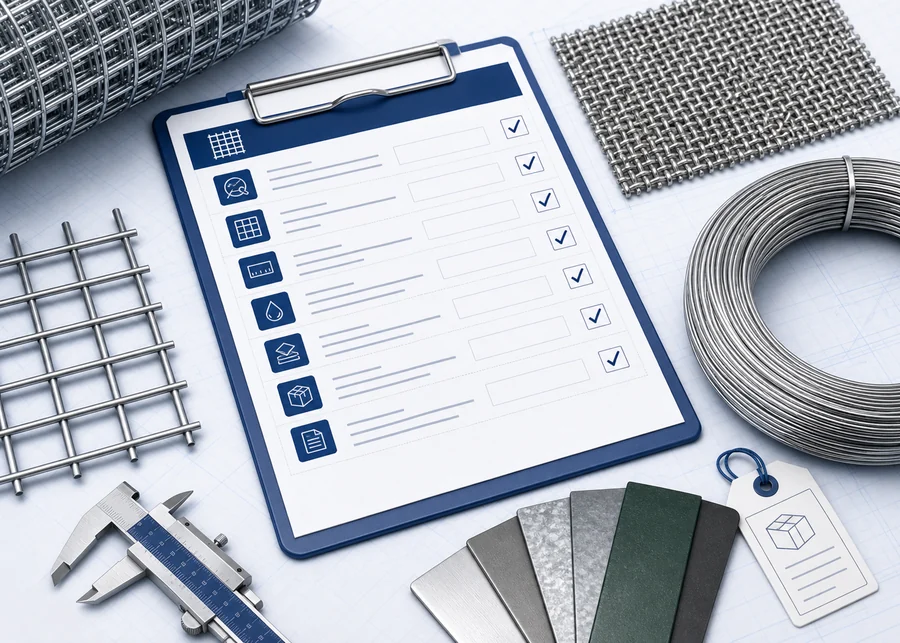
Before sending the inquiry, check whether the RFQ answers these questions:
- What product format is being requested?
- Which mesh opening measurement method is being used?
- Is the wire diameter stated in millimetres and linked to coating state?
- Does the buyer know unit weight, target weight or historical shipment weight?
- Is material separated from finish?
- Are roll, panel or sheet dimensions clear?
- Are edge condition and orientation relevant to the order?
- Is each specification listed with its own quantity?
- Are packing, labels and shipment proof requirements stated?
- Are drawings, photos or sample references attached?
- Are open questions marked clearly instead of hidden?
This checklist is especially useful when several departments are involved, such as purchasing, engineering, quality control and warehouse receiving.
Common RFQ mistakes to avoid
The most common mistake is sending only a product photo and asking for a final container price. A photo can start the discussion, but it does not define measurement method, material, finish, quantity or packing.
Other avoidable issues include:
- mixing several specifications in one paragraph;
- using gauge numbers without a gauge reference;
- ignoring known weight even when the buyer has a previous order, sample or local market target;
- writing "galvanized" without saying which finish or document is required;
- asking for "best quality" instead of defining the application and acceptance method;
- changing packing or labels after production has started;
- treating an RFQ template as a substitute for drawing approval, sample approval or inspection.
If the RFQ is part of a new product or project-development process, keep sample records and bulk-order instructions aligned before mass production starts.
Frequently asked questions
What are the most important wire mesh specification RFQ fields?
The most important fields are product format, mesh opening, wire diameter, unit or target weight, material, finish, size, edge condition, quantity, packing, destination and attachments. The exact fields depend on the product family, but these items usually prevent the most common quotation assumptions.
Why is weight important in a wire mesh RFQ?
Wire mesh cost is strongly connected to metal weight. If the buyer can provide kg per roll, kg per panel, kg per square metre or total historical shipment weight, the supplier can check whether the requested size, mesh opening and wire diameter are consistent. Weight also helps identify quotation differences that come from lighter wire, different coating assumptions or packing changes.
Can a supplier estimate wire diameter from size and weight?
If the buyer provides reliable size, mesh opening, material and target weight, the supplier can often estimate a practical wire diameter range for quotation discussion. It is still an estimate until the final specification is confirmed by drawing, sample, measurement method or inspection requirement.
Should I send a drawing or a photo with the RFQ?
Send both when available. A drawing gives measurable fields, while a photo helps the supplier understand appearance, context or existing product references. The current drawing or latest approved sample photo should be clearly identified so the supplier does not quote from an outdated version.
Can one RFQ cover several wire mesh specifications?
Yes, but each specification should have its own row with size, mesh opening, wire diameter, material, finish, quantity and packing. This makes the quotation easier to compare and helps avoid mixed labels or receiving confusion.
Should material certificates or coating reports be requested in the RFQ?
If documents are required for the order, mention them in the RFQ and ask the supplier to confirm availability for that product and production route. Do not assume every product, finish or order size automatically includes the same certificate or test report.
Does a complete RFQ replace inspection?
No. A complete RFQ reduces quotation and production assumptions, but it does not replace drawing approval, sample approval, inspection, packing-list review or shipment release checks.
Prepare a wire mesh RFQ field list
Before asking for a final quotation, prepare one clear RFQ field list with product format, mesh opening, wire diameter, unit or target weight, material, finish, size, edge condition, quantity, packing, destination and attachments. Mark any uncertain field as open so the supplier can quote with a clear assumption instead of guessing.
ANJIA GROUP can review wire mesh RFQ fields for order-specific inquiries and help buyers organize specification, weight, packing and shipment-proof questions. Send your current drawing, sample photo, target weight or field list through the ANJIA inquiry page for review.
About ANJIA GROUP
ANJIA GROUP supplies wire mesh, fencing and related industrial products for global B2B buyers. Contact our team to discuss product specifications, matching accessories and export packing.
Discuss your sourcing requirements
Send your product requirements and any relevant drawings to our team.
Get a Free Business Quote Wire Mesh Products
 Welded Wire Mesh
 Wire Mesh RFQ Specification Builder
 Wire Mesh RFQ Checklist