Hot Dip Galvanized vs Electro Galvanized Wire Mesh: Finish, Use Cases and RFQ Questions
Updated Jul 12, 2026
Compare hot-dip and electro galvanized wire mesh by finish, weld-point route, application fit, handling, packing and RFQ wording for importers.
Table of contents
When an overseas buyer asks for "galvanized wire mesh," the specification is still incomplete. Galvanizing can refer to different coating routes, and two common options are hot-dip galvanized and electro galvanized wire mesh.
The difference matters because coating route can affect appearance, weld-point review, packing expectations, quotation basis and how the buyer compares suppliers. This guide explains the practical questions importers should clarify before quotation. It does not treat one method as universally better. The right choice depends on product type, application, exposure environment and buyer specification.
For buyers still building a broader RFQ, the wire mesh buying guides hub and the recent guide on galvanized vs PVC coated wire mesh can help connect finish selection with coating, packing and application questions.

What hot-dip and electro galvanizing mean
Hot-dip galvanizing normally means the steel wire, mesh or formed product is coated through contact with molten zinc after surface preparation. Depending on the product route, the coating may be applied to wire before forming, or to the finished welded or formed mesh afterward.
Electro galvanizing, also called electroplating in many sourcing discussions, uses an electrochemical process to deposit zinc on the steel surface. The surface often looks smoother and brighter than hot-dip galvanized material.
For importers, the key point is simple: the word "galvanized" is not enough. The RFQ should state which route is required, or ask the supplier to quote both options separately with the coating basis clearly identified.
Appearance: do not judge only by shine
Hot-dip galvanized surfaces often look more matte, textured or visibly zinc-coated. Depending on product and process, the surface can show spangle, thicker coating appearance, zinc buildup around intersections or a less mirror-like finish.
Electro galvanized surfaces often look smoother, brighter and more uniform. This can be attractive for indoor or clean-looking products, but a bright appearance does not automatically mean heavier zinc protection.
Buyers should be careful with visual judgment. A surface that looks clean may still have a thin coating. A surface that looks less uniform may still be the more suitable choice for a demanding outdoor application. The quotation should define coating route and coating requirement instead of relying only on photos.
Before welding vs after welding
For welded wire mesh, buyers also need to ask whether galvanizing happens before or after welding.
If wire is galvanized before welding, the mesh is welded after the wire has already been coated. Weld points may show darker marks or different surface appearance because heat affects the coating at the intersection.
If the mesh is galvanized after welding, the welded mesh is coated after the intersections are already formed. This can give more complete coating coverage around weld points, although the final appearance and coating buildup still depend on product, process and supplier control.
This distinction is especially important for welded mesh panels, fence panels and other products where weld intersections are visible or exposed. For woven or twisted products, the same welding distinction may not apply, but the buyer still needs to clarify the coating route.

Coating requirement: what buyers should ask for
Many disputes start because the buyer writes only "galvanized mesh" and expects the supplier to understand the intended coating level. A clearer RFQ should include coating route and a measurable coating requirement where relevant.
Useful RFQ questions include:
- Is the product hot-dip galvanized or electro galvanized?
- Is galvanizing done before or after welding, weaving or forming?
- What coating weight or coating thickness is being quoted?
- What test method or inspection record can be provided if coating confirmation is required?
- Are the quoted samples, production photos and packing photos from the same coating route?
- Are there visible weld-point or surface-finish expectations that must be agreed before production?
The exact measurement unit may depend on product type, buyer standard and supplier practice. Some buyers request coating weight; others request thickness readings or inspection records. The important point is to define the requirement before comparing prices.

Application fit: typical buyer thinking
Hot-dip galvanized mesh is often considered when outdoor exposure, heavier-duty use or stronger coating reserve is part of the buyer's expectation. Typical discussions may involve fence panels, agricultural mesh, gabion-related products, construction use, utility mesh and other products where appearance is not the only decision factor.
Electro galvanized mesh is often considered when the buyer needs a clean bright finish, indoor use, lighter-duty use or a product where cost and appearance are balanced differently. It may be suitable for many applications, but the buyer should confirm whether the coating route matches the expected exposure environment.
This is not a replacement for project engineering or buyer standards. It is a sourcing framework. Buyers should define product use, environment, coating route, packing and inspection requirement together before making a decision.
Handling, storage and white rust risk
Both hot-dip galvanized and electro galvanized products need reasonable handling and storage. Galvanized surfaces can develop white rust if packed or stored in damp, poorly ventilated conditions. This is not limited to one coating route.
Because electro galvanized surfaces are often brighter and thinner-looking, handling marks can be more visible. Hot-dip galvanized products may tolerate ordinary handling marks better visually, but they still require proper packing, especially for export shipment and long storage time.
For importers, practical storage and packing questions include:
- Will the goods be packed dry and protected before container loading?
- Will rolls or panels be separated where rubbing may affect surface appearance?
- Will the supplier provide packing photos before shipment?
- Should the goods avoid direct ground contact after arrival?
- Is warehouse ventilation needed before installation or resale?
For shipment proof, buyers can also use the wire mesh export packing photo checklist to request order-specific photos before loading.

How to write the RFQ
Instead of asking only for "galvanized wire mesh," buyers can use clearer wording.
For hot-dip galvanized products:
- state
hot-dip galvanizedin the specification; - clarify whether coating should be before or after welding when the product is welded;
- request the coating requirement and inspection basis if needed;
- ask for surface, weld-point and packing photo references before production or shipment.
For electro galvanized products:
- state
electro galvanizedorelectroplated galvanizedin the specification; - confirm whether the supplier uses the term
cold galvanizedand what it means in their quotation; - request the coating basis and surface expectation;
- confirm whether the product is intended for indoor, light-duty, temporary or protected use.
If either route is acceptable:
- ask the supplier to quote hot-dip galvanized and electro galvanized options separately;
- require each option to state coating route, product size, packing method and inspection basis;
- compare quotation, application fit and packing requirement together, not price alone.
Buyers can review product families through the ANJIA product center and send coating-route questions through the inquiry page.
Connect coating choice with proof
The practical decision is not whether hot-dip galvanized is always better than electro galvanized. The buyer should decide which coating route fits the product use, environment, appearance expectation, budget and inspection requirement. A bright surface, a grey surface or a product photo alone is not enough to prove coating route or coating reserve.
For welded mesh, the coating route should also be linked with weld-point review. A buyer comparing galvanized-before-welding and galvanized-after-welding should ask how weld intersections will look, whether coating records are available for the order, and whether packing will reduce white rust and surface marks during ocean freight. If weight or coating basis is part of the buyer's standard, the RFQ should state the unit, method and acceptable document type before quotation.
| Buyer decision | Useful proof | What to confirm separately |
|---|---|---|
| Outdoor exposure or heavier-duty use | Coating route statement, coating basis and product photos tied to the order. | Photos show appearance; they do not replace agreed coating records or tests. |
| Clean bright finish or indoor use | Electro galvanized specification, surface photos and packing plan. | Bright appearance does not prove heavier zinc protection. |
| Weld-point coverage | Supplier note on galvanized-before-welding or galvanized-after-welding, plus weld close-ups. | Final acceptance should follow the buyer's project or inspection requirement. |
| Shipment and storage risk | Packing photos, ventilation plan, label and loading photos. | Packing proof reduces uncertainty but cannot guarantee destination storage conditions. |
A clearer coating proof request helps both sides compare the same finish, instead of revising the quotation after samples, photos or shipment documents reveal different assumptions.
Quick comparison checklist
Use this checklist before comparing quotations:
| Check point | Hot-dip galvanized | Electro galvanized |
|---|---|---|
| Typical appearance | May look more matte, textured or zinc-heavy. | Often brighter, smoother and more uniform. |
| Welded mesh question | Ask whether galvanizing is before or after welding. | Ask how weld points and coating basis are controlled. |
| Quotation comparison | Compare coating route, coating basis, packing and application together. | Do not compare by shine or unit price alone. |
| Buyer proof | Request photos or coating records when the order requires them. | Confirm inspection basis before production when coating matters. |
- Process name: confirm whether the quoted item is hot-dip galvanized or electro galvanized.
- Surface appearance: hot-dip may look more textured or matte; electro galvanized may look brighter and smoother.
- Weld-point route: for welded products, confirm galvanized before welding or galvanized after welding.
- Coating requirement: ask for coating weight, thickness or inspection basis when it matters to the order.
- Application fit: match coating route to indoor, outdoor, visible, agricultural, construction or fencing use.
- Packing risk: confirm interleaving, wrapping, dry packing and loading photos when surface appearance matters.
- Documentation: request inspection photos or coating-related records only when required by the order.
- Quotation basis: compare options only when the coating route and specification are written clearly.
FAQ
Does "galvanized" always mean hot-dip galvanized?
No. In sourcing communication, "galvanized" can refer to hot-dip galvanized, electro galvanized or other zinc-related descriptions depending on the supplier and product. Buyers should ask the supplier to state the exact coating route.
Can buyers identify hot-dip vs electro galvanized by appearance?
Often, but not always. Hot-dip galvanized surfaces may show a more textured or spangled zinc appearance, while electro galvanized surfaces may look smoother and brighter. For order confirmation, buyers should rely on written specification and inspection basis rather than visual judgment alone.
Is galvanized after welding always required?
No. Galvanized after welding can be important when weld-point coverage matters, especially for exposed welded products. But some indoor, light-duty or cost-sensitive applications may use galvanized-before-welding products. The buyer should match the choice to product use and expected exposure.
Should I ask for coating thickness in every RFQ?
If coating performance or comparison between suppliers matters, asking for a coating basis is useful. The exact field can be coating weight, thickness or inspection method depending on product type and buyer requirement. Avoid comparing prices when one supplier has quoted a different coating route.
How can ANJIA help with galvanized wire mesh specifications?
ANJIA GROUP can discuss galvanized wire mesh specifications based on product type, application, coating route, packing requirement and buyer documentation needs. Buyers can send the product type, size, wire diameter, mesh opening, coating preference, packing requirement and destination through the ANJIA inquiry page for a clearer quotation basis.
Clarity before quotation prevents disputes after delivery
Hot-dip galvanized and electro galvanized wire mesh can both be useful, but they should not be hidden behind one vague word: galvanized. The buyer needs to know which route is quoted, how weld points are handled, what coating basis is used and how the product will be packed.
Clear wording before quotation reduces the risk of mismatched samples, unexpected surface appearance, weak comparison between suppliers and disputes after delivery. For importers, a better RFQ is usually the simplest protection: state the coating route, confirm the application, ask for the relevant inspection basis and make the supplier quote on the same specification.
About ANJIA GROUP
ANJIA GROUP supplies wire mesh, fencing and related industrial products for global B2B buyers. Contact our team to discuss product specifications, matching accessories and export packing.
Discuss your sourcing requirements
Send your product requirements and any relevant drawings to our team.
Get a Free Business Quote Wire Mesh Products
 Welded Wire Mesh
 Fence Coating & Exposure Zone Selector
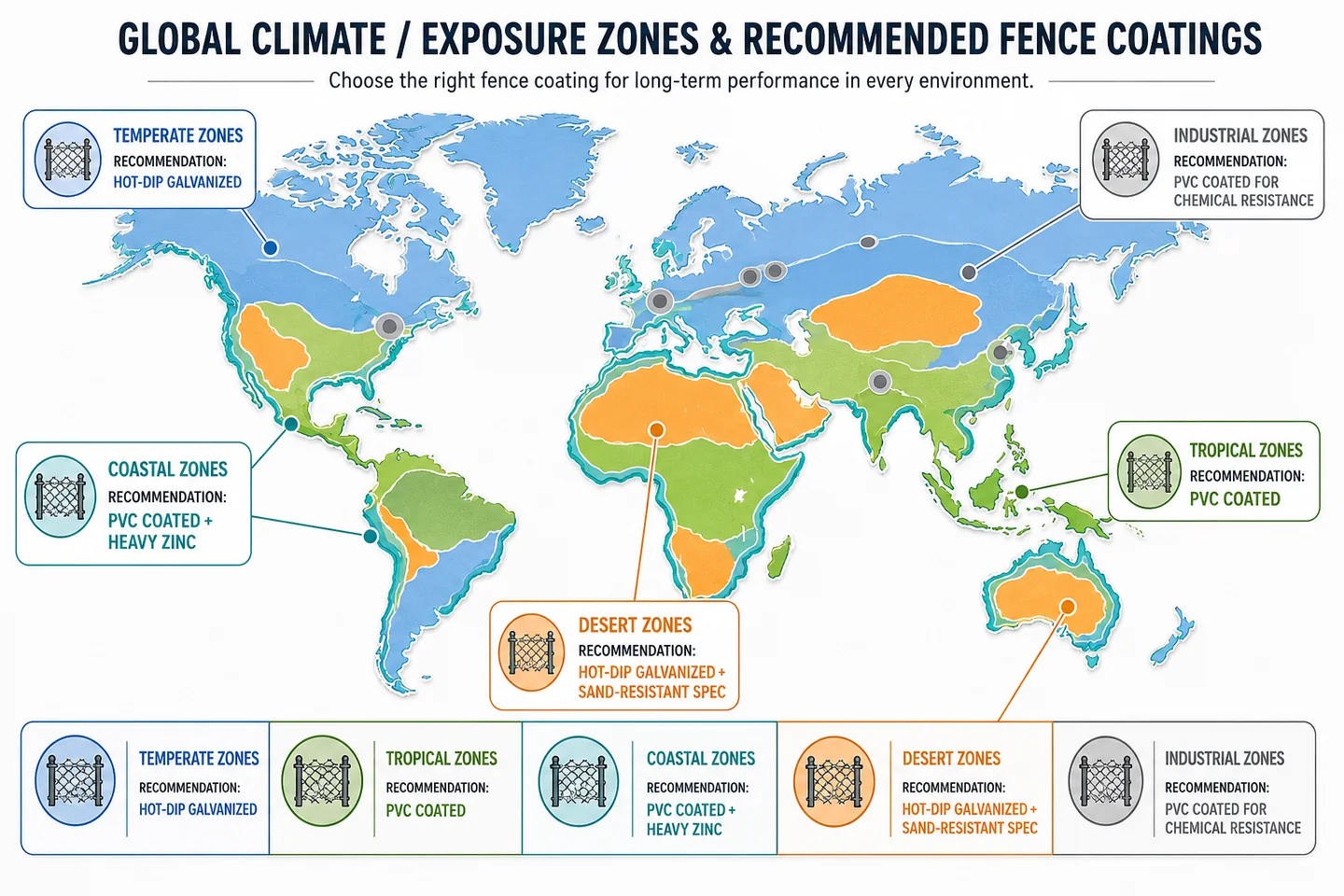 Galvanized vs PVC Coated Wire Mesh Guide