
Welded Mesh Panels vs Rolls: How Importers Choose the Right Format
Updated Jun 24, 2026
Compare welded mesh panels and rolls by rigidity, cutting, storage, packing, loading and RFQ wording for B2B importers.
Table of contents
When a buyer asks for welded wire mesh, the quotation is not complete until the physical delivery format is clear. The same mesh opening, wire diameter and surface finish may be supplied as flat panels or as rolls, but the two formats behave differently in storage, handling, packing, loading and installation planning.
This guide helps importers compare welded mesh panels and welded mesh rolls from a purchasing point of view. It is not a claim that one format is always better. The right choice depends on the application, warehouse space, cutting method, packing expectation and how the goods will be used after arrival.
For buyers building a broader RFQ, the wire mesh buying guides hub and the guide to wire mesh export packing photos can help connect format choice with packing and shipment proof.

What changes when welded mesh is supplied as panels or rolls
Panels and rolls can start from the same welded mesh specification. The difference is the form in which the mesh is delivered.
Welded mesh panels are supplied as flat sheets. They are easier to stack, inspect and install when the buyer needs a rigid, pre-cut format. Panels are commonly discussed for flat partitions, guards, shelf inserts, reinforcement references, cages, project fabrication and fence sections.
Welded mesh rolls are supplied as coiled mesh. They are easier to move through some job sites, cut to different lengths and use where the mesh needs to follow a longer run or a less rigid shape. Rolls are commonly discussed for enclosure runs, light fencing, agricultural use, temporary coverage and jobs where installers prefer cutting on site.
The format decision affects logistics as much as product use. Buyers should define the form before comparing prices, because panel packing and roll packing are not the same job for the factory.
Rigidity and application fit
Panels hold a flatter shape. This is useful when the mesh needs to remain straight, sit in a frame, be stacked as a finished component or be installed as a pre-sized section. If a buyer needs a flat surface with limited bending, panels are often easier to specify.
Rolls provide more flexibility. They can be unrolled and cut to match different lengths, which can reduce on-site waste when each section is not identical. Rolls can also be easier for continuous runs, curved areas or jobs where the installer does not want to handle many rigid sheets.
The buyer should not choose only by unit price. A lower product price can be offset by extra cutting, handling, storage or surface-protection work after arrival. A better RFQ asks suppliers to quote the format that matches the actual work flow.
Cutting and handling at the destination
Panel orders usually reduce on-site cutting when the ordered size matches the project. This can save time for repeat sizes or workshop fabrication. However, if the panel is too large, too heavy or needs many adjustments, handling can become difficult.
Roll orders give the installer more flexibility. The mesh can be unrolled gradually and cut to the required length. This is useful when different bays, fence runs or enclosure sections do not share the same size.
The trade-off is clear:
- panels are easier when the buyer already knows the final size;
- rolls are easier when lengths vary or site cutting is expected;
- heavier specifications may make either format harder to handle;
- coated products may need extra attention after cutting because exposed wire ends can affect appearance or corrosion resistance.
Packing and loading: why format changes shipment planning
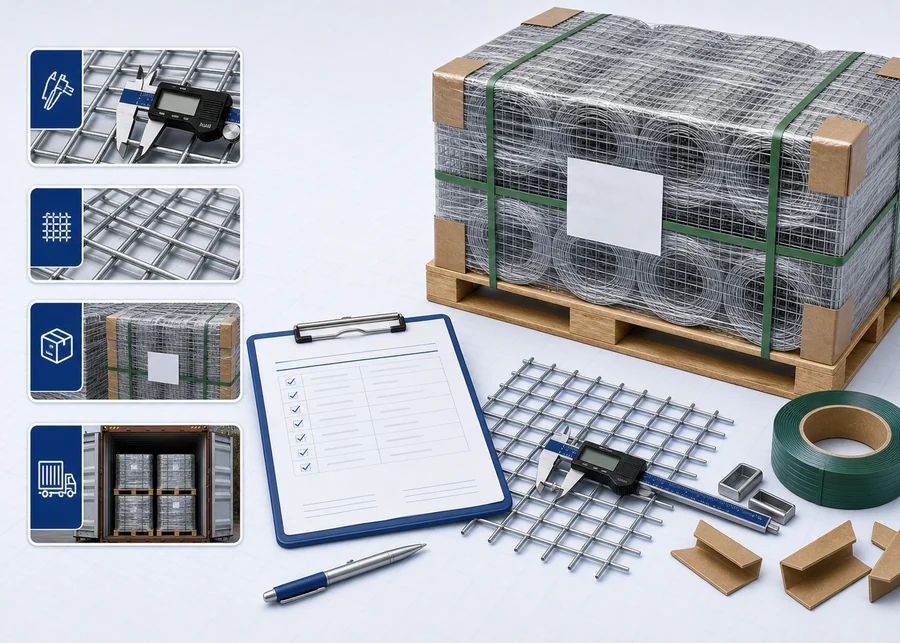
Panels are commonly packed as flat stacks on pallets or wooden supports. The packing plan may include spacing blocks, film, straps, edge protection or other protection depending on product size and surface finish. The buyer should ask for packing photos that show the stack condition, pallet base and strapping method.
Rolls are commonly wrapped individually or bundled in groups. They may be loaded upright, laid down or palletized depending on roll size, wire gauge, coating and container plan. For visible coatings such as PVC coated or bright galvanized finishes, buyers should ask how the supplier reduces rubbing during transport.
When the shipment includes multiple mesh types, posts, fittings or mixed cargo, the supplier should explain the loading plan. Format choice can affect how efficiently the container space is used, but container loading should be confirmed by the actual product dimensions, quantity and packing method.

Warehouse storage and distribution
Panels need flat storage space. They can be stacked neatly, but they occupy their full footprint and usually need forklift or pallet handling when the stack is heavy. Buyers distributing panels should check whether the warehouse can handle the panel dimensions and stack weight.
Rolls can be more compact in floor footprint, but they need control against movement, deformation or surface damage. Upright storage may save space, while horizontal storage can be easier for some products. The best method depends on roll size, stiffness and how the buyer will pick and ship the goods later.
For distributors, storage is not a minor detail. If goods will be resold or split into smaller orders, the format should match how the warehouse counts, moves and protects inventory.
RFQ wording for panels
For panel orders, the RFQ should state:
- welded mesh panel or welded mesh sheet;
- panel width and length;
- wire diameter and mesh opening;
- surface finish, such as galvanized, PVC coated or plain steel;
- quantity by pieces or total area;
- edge trimming or frame requirement if applicable;
- pallet packing and protection expectation;
- whether packing photos are required before shipment.
If the panel will be used in fabrication, the buyer should also clarify whether size tolerance, flatness, edge condition or sample approval matters for the order. These points should be handled as order-specific requirements, not assumed automatically.
RFQ wording for rolls
For roll orders, the RFQ should state:
- welded mesh roll;
- roll width and roll length;
- wire diameter and mesh opening;
- surface finish;
- number of rolls or total area;
- core or coreless preference if relevant;
- roll wrapping and label requirement;
- whether rolls will be loaded upright, palletized or shipped according to a supplier loading plan.
The buyer should also ask whether the mesh specification can be rolled without creating excessive springback or deformation. Some heavier or stiffer specifications may be more practical as panels, while lighter specifications may work well as rolls.
How to compare quotations from suppliers
When comparing panel and roll quotations, buyers should compare more than unit price.
Practical comparison points include:
| Decision point | Panels | Rolls |
|---|---|---|
| Format control | Better when the buyer needs flat, repeated sizes. | Better when the buyer needs continuous length or site cutting. |
| Packing review | Check pallet base, stack height, edge protection and strapping. | Check wrapping, roll labels, compression and loading orientation. |
| Warehouse handling | Needs flat storage space and suitable lifting equipment. | Can reduce floor footprint but needs control against movement or deformation. |
| RFQ wording | State panel width, length, quantity and pallet expectation. | State roll width, roll length, roll count and wrapping or label needs. |
- product cost for the same mesh specification;
- packing method and photos;
- loading method and container plan;
- expected handling equipment at destination;
- cutting work after arrival;
- surface protection during transport;
- storage space and distribution process;
- whether the supplier can quote both formats clearly.
If both formats are possible, it is reasonable to ask for two quotation lines: one for panels and one for rolls. This helps the buyer compare the total sourcing cost instead of selecting the format only by habit.

Quick comparison checklist
- Use panels when: the project needs flat pre-sized mesh, repeated dimensions, easier visual inspection or rigid finished sections.
- Use rolls when: the project needs continuous length, site cutting, flexible handling or better fit for varied section sizes.
- Ask about packing: panels and rolls need different protection plans.
- Ask about loading: container efficiency depends on actual product size and packing, not only on format name.
- Ask about handling: warehouse equipment and installation method can change the real cost.
- Avoid vague RFQs: do not write only "welded mesh"; state panel or roll format clearly.
FAQ
Can the same welded mesh specification be supplied as both panels and rolls?
Often yes, but not always. The practical answer depends on wire diameter, mesh opening, stiffness, coating and the buyer's expected roll size or panel size. A supplier should confirm whether the requested specification is practical in both formats before quoting.
Which format is cheaper to ship?
There is no universal answer. Rolls may use space efficiently for some orders, while panels may load more predictably for others. The buyer should compare the actual packing plan, container arrangement and destination handling cost.
Are panels better quality than rolls?
No. Format is not the same as quality. Quality depends on mesh specification, welding consistency, surface finish, inspection and packing. Panels and rolls can both be suitable when produced and packed correctly.
Can rolled welded mesh be flattened after arrival?
Some rolls can be flattened for use, but stiffness and springback depend on the specification. If the project requires a very flat surface, panels may be the safer format to discuss with the supplier.
How can ANJIA help buyers compare the two formats?
ANJIA GROUP can review the buyer's mesh specification, expected use, packing needs and shipment plan, then discuss whether panels, rolls or both quotation options are more practical. Buyers can send dimensions, wire diameter, mesh opening, surface finish, quantity and destination through the ANJIA inquiry page for a clearer quotation basis.
Format choice is part of the sourcing decision
Panels and rolls are not only product forms. They are sourcing decisions that affect packing, loading, handling, storage and installation work after arrival.
The strongest RFQ does not leave the format open. It states the expected form, asks the supplier to confirm practicality, requests suitable packing photos and compares the total order workflow. For importers, that clarity can reduce quotation confusion and make supplier comparisons much easier.
About ANJIA GROUP
ANJIA GROUP supplies wire mesh, fencing and related industrial products for global B2B buyers. Contact our team to discuss product specifications, matching accessories and export packing.
Discuss your sourcing requirements
Send your product requirements and any relevant drawings to our team.
Get a Free Business Quote Wire Mesh and Fence Products
 Wire Mesh Products
 Factory, QC & Packing Reference Pack
 Wire Mesh RFQ Checklist